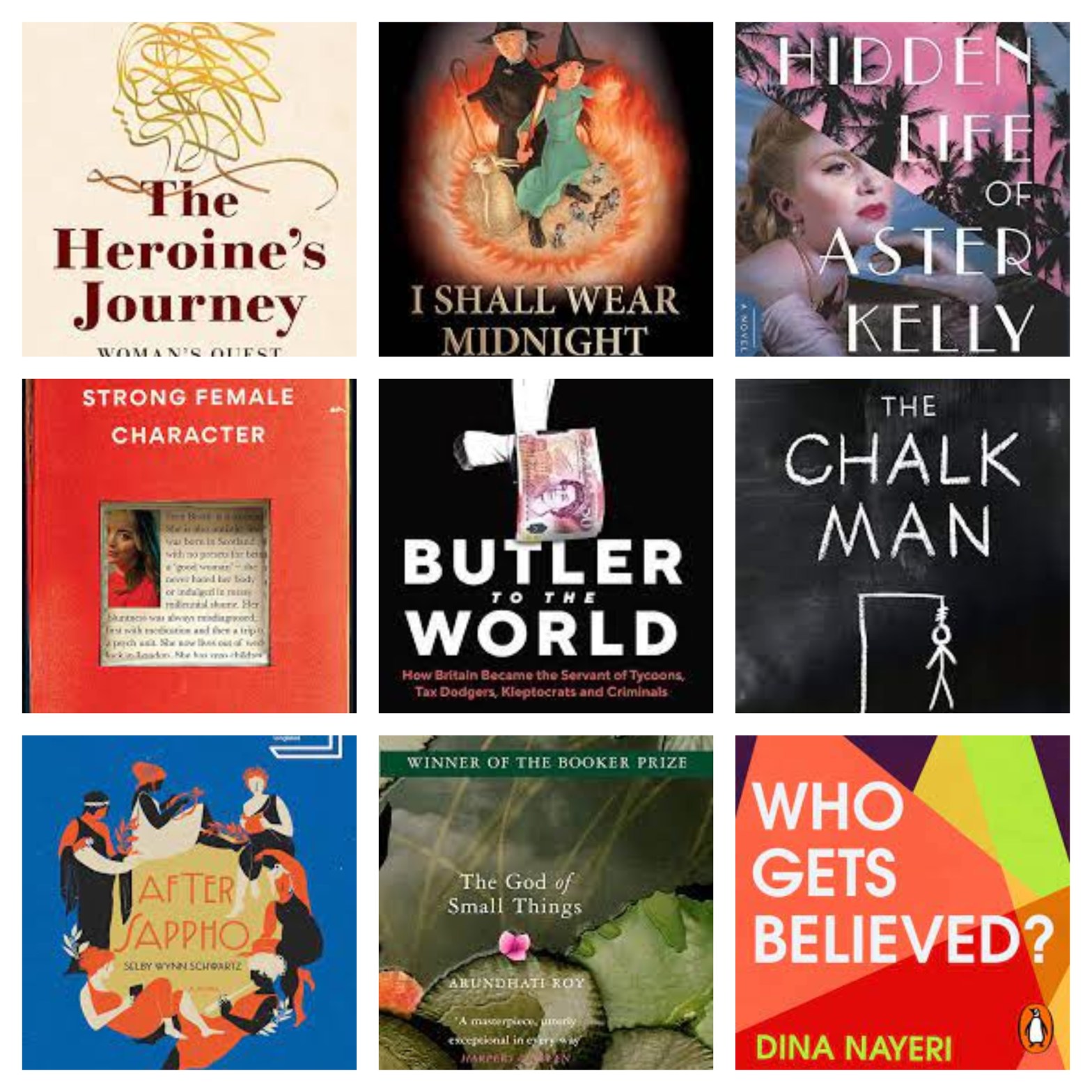
The Heroine’s Journey: Women’s Quest for Wholeness by Maureen Murdock
If, like me, you picked this book up thinking that it is a feminist response to Joseph Campbell’s idea of the Hero’s Journey, you’ll find yourself disappointed. Less literary theory and more self-help, Murdock posits that women have been defined according to masculine values and successes and that a heroine must reconnect with the ‘wounded feminine’ in order to achieve a state of wholeness. I was with her up to a point (always happy to participate in the dismantling of patriarchal institutions) but the whole thing felt just a bit too much like gender essentialism with some crystals and new age mysticism sprinkled in to distract you. While I enjoyed the sections that actually focused on mythology and goddess narratives, the long sections on the author’s dreams felt a tad irrelevant to the overall aim of the book. Ultimately The Heroine’s Journey feels remarkably dated and too narrow to actually help anyone looking to learn more about narrative and story-telling so I definitely don’t recommend it for those purposes.
I Shall Wear Midnight by Terry Pratchett
There’s yet to be a Discworld novel that I don’t love, but there will always be a special place in my heart for Tiffany Aching and her Wee Free Men. In this installation Tiffany must balance her responsibilities as witch of the Chalk with addressing increasingly violent anti-witch sentiment and preparations for her ex-kinda-boyfriend’s upcoming nuptials. Pratchett really is a master of cloaking very real truths about coming of age and being an outsider in a fantasy setting to create stories that feel fantastical and transporting and yet also incredibly true and relatable. These books are so special to me and I’m dreading the day that I reach the end of the series.
The Hidden Life of Aster Kelly by Katherine A. Sherbrooke
Perfect for fans of the The Seven Husbands of Evelyn Hugo and Daisy Jones and the Six, The Hidden Life of Aster Kelly is a highly readable historical fiction novel that grapples with the price of success, the value of found family and the conflict that so often ensues out of the public eye when the two collide. A dual narrative, with one half focusing on the glamorous Aster Kelly in 1940s and her dreams of becoming a fashion designer as the world tries to pin her into the role of model and muse, and the other half focusing on her daughter Lissy in 1970s New York as she tries to make a name for herself on the Broadway stage. If you’re looking for an engrossing, intelligent read to keep you entertained this summer that’s still light enough to read on the beach, this book is for you.
Strong Female Character by Fern Brady
If you’re not already a fan of Fern Brady, sort your life out because she is outrageously funny. I’ve been following her stand up for ages and in it she is quite open about her recent diagnosis of autism. So I was surprised when reading her memoir about how much she resisted the idea that she was autistic and how much shame she initially associated with her diagnosis. The memoir itself is a hard-hitting and furious account growing up as a neurodiverse woman in working-class Glasgow and tackles mental health, abusive relationships, educational struggles and sex work. It is a testament to Brady’s incredible talent that in spite of its pretty heavy subject matter, it is still immensely entertaining to read. Brady’s pitch-black sense of humour keeps the story flowing while never letting the reader lose sight of the invisible barriers that neurodiverse women face. Whether or not you are autistic, this book with both entertain and educate you.
As the world rushed to sanction Russia following their invasion of Ukraine, suddenly it felt like everyone was talking about the issues of dirty money, kleptocracy and economic crime. Although there is seemingly a political consensus in the U.K. on the need to crack down on illicit finance, Bullough’s detailed polemic against Britain’s role in the global offshore economy makes it uncomfortably clear that this is a very recent development indeed. He begins his story in the aftermath of the Suez Crisis in 1956 when Britain is still reeling from humiliation and having an identity crisis about their role in the world as their once immense influence wains. Bullough posits that in the absence of any particular hard power of its own, Britain fashioned itself into an enabler and fixer for the the world’s dodgiest oligarchs. Whether it’s the arcane system of Scottish limited partnerships, gambling tax rates in Gibralter or tax havens in the Cayman Islands, Britain has and continues to play an outsize role in facilitating financial dirty tricks and this book is a must read for anyone who wants to understand how much further there is to go in closing these loopholes.
The Chalk Man is a thriller that alternates between two timelines, one in the 1980s, when a young Eddie and his friends leave each other childish chalk messages around town until a gruesome murder gives their symbols disturbing new significance, and one now, as an adult Eddie grapples with what happens all those years ago and begins to look at them with fresh eyes as some of his old friends begin to turn up dead. While there were plenty of twists and turns, they were fairly predictable and I didn’t find the plot particularly compelling. This was a perfectly passable thriller with which to pass the time but I’d need it to be significantly more thrilling before I recommended it!
After Sappho by Selby Wynn Schwartz
I’m pretty sure this book was genetically engineered in a lab to make me happy. Historical fiction about the feminist movement? Check. Copious amounts of love for Latin and Ancient Greek? Check. Communities of female artists and thinkers creating beautiful work together? Check. Everyone is a lesbian? Check. This novel of vignettes of brilliant and transgressive female creatives throughout the late nineteenth and early twentieth century is sweeping, empowering and beautifully written. I cannot recommend it enough and if there is any justice in the universe then spirit of Sappho knows that this book exists and is weeping with joy to see all of the brilliant women who are her legacy.
The God of Small Things by Arundhati Roy
This novel has been on my list for a long time and it was a real pleasure to finally sit down and enjoy it. The God of Small Things is a tragic but beautiful story of a family on the brink of destruction and Roy guides the reader through the series of seemingly small events that move them inexorably towards disaster. The characters are vividly drawn and truly feel like real, fully fleshed out people, whether they tug at your heartstrings or make you want to punch them in the face. Roy’s writing is dream-like, winding you through space and time at a leisurely pace, while still being grounded firmly in the reality of India in the late sixties and the caste-based discrimination that was rife at the time. I know this book has been controversial but I found it to be a deeply moving joy to read and heartily recommend it.
Who Gets Believed?: When The Truth Isn’t Enough by Dina Nayeri
Halfway between memoir and essay, Who Gets Believed? poses fascinating questions about the nature of truth and belief and the seemingly small and irrational things that render someone ‘credible’. Nayeri draws on her experience of the asylum system, consultancy, childbirth and more to put the spotlight on the unspoken social codes that regulate who we as a society choose to trust. What I found particularly interesting about this book is that Nayeri is no less critical of herself than she is of the rest of the world, spending a significant amount of time interrogating why she struggles to give credence to her brother in law’s mental health struggles and the significant amount of guilt and shame she carries around the judgements she made on that topic. This thought-provoking book should prompt all of us to take a closer look at who we trust implicitly and who we still feel distrustful of, in spite of what’s right in front of our eyes.
The Rachel Incident by Caroline O’Donoghue
I’m a huge fan of Caroline O’Donoghue’s fantastic podcast Sentimental Garbage and so I was thrilled when NetGalley sent me an advance copy of her latest novel in exchange for a review. As I’d hate to have to say anything less than complimentary about someone so cool, I’m thrilled to say that it fully fulfilled my high expectations and I thoroughly enjoyed it! The Rachel Incident is set in Cork in the late 2000s as Ireland is reeling off the back of a recession and employment is scarce. Our protagonist, Rachel, has just moved in with her brilliant, charismatic and closeted co-worker and the two of them tear up the Cork nightlife as they embrace an artsy and bohemian lifestyle. But when their lives become increasingly entangled with the life of Rachel’s married English professor, Dr Byrne, things begin to spiral out of control very quickly. I love how this novel captures the rush of mad, passionate and all-encompassing friendship, the glories and horrors of being an absolute mess in your twenties and the claustrophobic nature of growing up in a country where everyone seems to know everyone else and therefore your mistakes can haunt you for years to come.
Lady Chatterly’s Lover by D.H. Lawrence
One of the most controversial books of all time of its not only because of its explicit descriptions of sex and pleasure but also for its depiction of a relationship that crosses class boundaries, Lady Chatterly’s Lover is a great work of literature in its own right as well as a window into the anxieties of the British establishment in the Inter-War period. The novel centres around the eponymous Lady Constance Chatterly, a passionate young woman whose aristocratic and intellectual husband has been injured in World War I. He is completely paralysed from the waist down and Constance quickly finds herself acting much more as a nurse and a secretary than a wife, with her husband neglecting her emotional and physical needs and insisting that their marriage can go on perfectly happily even if they only engage with each other on an intellectual and logical level. Constance finds herself wasting away, unable to live a life of the mind and craving a connection to the physical world of nature and emotion. On her regular long walks through the grounds of their estate, she strikes up a relationship with Oscar Mellors, the gamekeeper, and the two embark on a passionate love affair that turns Constance’s world upside down. Absolutely a novel that must be read at least once over the course of a lifetime.
Snow Country by Yasunari Kawabata
Another novel fraught with frustrated passion and loving descriptions of nature, but this time set in the snowy mountains of western Japan. There’s not much by way of plot in this novel, which recounts the one-sided but passionate affair between a Tokyo business man and a rural geisha and the enigmatic young woman who will obliviously throw it into disarray. From the beginning a sense of doom and sorrow underscores the affair but the beauty is in how Komako, the geisha, continues to throw herself fully it even knowing that she is destined to be left heartbroken. This is a sparse and beautiful novel, much like the snowy landscape where it is set, but do not be fooled into thinking it is dull. Like a great white tundra it can appear plain and empty but a curious eye and patience will reveal that it sparkles in the right light.
Northanger Abbey by Jane Austen
I think it’s fair to say that Northanger Abbey is very much the red-headed stepchild of Jane Austen’s oeuvre. A slightly odd mish-mash of gothic parody, meta-textual commentary on novels, a comedy of manners and a love story, I can understand why this particular Austen novel is not for everyone. I, however, am ride or die for Catherine Morland and think that if you’re skipping Northanger Abbey you’re missing Austen at her sassiest. She is at the peak of her powers in the earlier scenes set in Bath, effortlessly skewering society’s more loathsome characters and summoning heart-pounding tension from seemingly low stakes social interactions. There is no other author living or dead capable of making me want to scream ‘let her out of that damn carriage’ on a crowded train. What truly makes Northanger Abbey charming though it its heroine. While Catherine is a walking disaster who manages to obliviously create chaos wherever she goes, she is so well-intentioned and so single-minded in her desire to do the right thing that you cannot help but root for her, even as she sort of accuses her prospective father-in-law of murdering his wife. A true hidden gem in the Austen canon.
The Price of Salt by Patricia Highsmith
Many will know The Price of Salt better through its film adaption Carol, which stars Cate Blanchett and Rooney Mara. However, even if you’ve seen the film, the novel is still well worth your time. Another tale of repressed longing that goes against the social mores of its time (I’ve clearly been in a mood recently), The Price of Salt tells the story of Therese, a young set designer who falls passionately and obsessively in love with Carol, an older woman who is going through a divorce. The two embark on a clandestine affair but when Carol’s husband gets wind of their relationship, Carol is forced to choose between continuing to have access to her child and continuing her relationship with Therese and living her life authentically. Although it is the centre of the novel, the love story here left me feeling rather cold – I couldn’t really see what was keeping Therese and Carol together other than all that forbidden passion and sexual attraction. However, I was moved by the elements of the story which focused on Therese’s coming into herself and coming of age. While as a romance it leaves something to be desired, as a Bildungsroman and coming out story, The Price of Salt excellent.
A Gathering of Shadows by V.E. Schwab
It’s always a shame when a sequel doesn’t live up to the potential of the excellent first book in the series. I was totally captivated by A Darker Shade of Magic’s great world-building, tightly knit plot and engaging characters but unfortunately A Gathering of Shadows has lost its way. It’s clear that Schwab is building to something with this series but this book just felt like filler to get us there rather than an engaging story in it’s own right. I cannot for the life of me understand the point of the whole Element Games plot line and the extremely contrived means by which our main characters participated in it stretched the bounds of common sense even for a fantasy novel where extra-dimensional travel is possible. I’ll still be giving the next book in the series a shot in the hopes that it returns to something resembling its initial brilliance, but even if it does its still disappointing that the magic couldn’t last the whole way through the series.
Babel: An Arcane History by R.F. Kuang
This is legitimately one of the best novels I’ve ever read. Babel is set in an alternative version of Oxford in the late 1800s in which the British empire has grown richer than ever before using ‘silverwork’, a form of magic that stems from the things that are lost in translation from one language to another. To keep the magic flowing, the empire must rely on the linguistic talents of young people from the farthest corners of the world, bringing them to Oxford and giving them the chance to rise high as valued cogs that keep the wheels of expansion and conquest turning. But some are not content to allow the British to run roughshod over their motherlands and our heroes must decide how far they are willing to go fight back against the empire. A stunning book that manages to be an immaculately constructed fantasy world, a gripping story of revolution, a polemic against the insidious nature of colonialism, a love letter to language and a meditation on what it means to translate, this novel ticked boxes I didn’t even know I had and I cannot recommend it enough.
 Kindled Spirits
Thank you for that review, Molly!! I hope it kept you entertained (and maybe even had moments of surprise? 🙂 xoxo Kathy
>
LikeLike