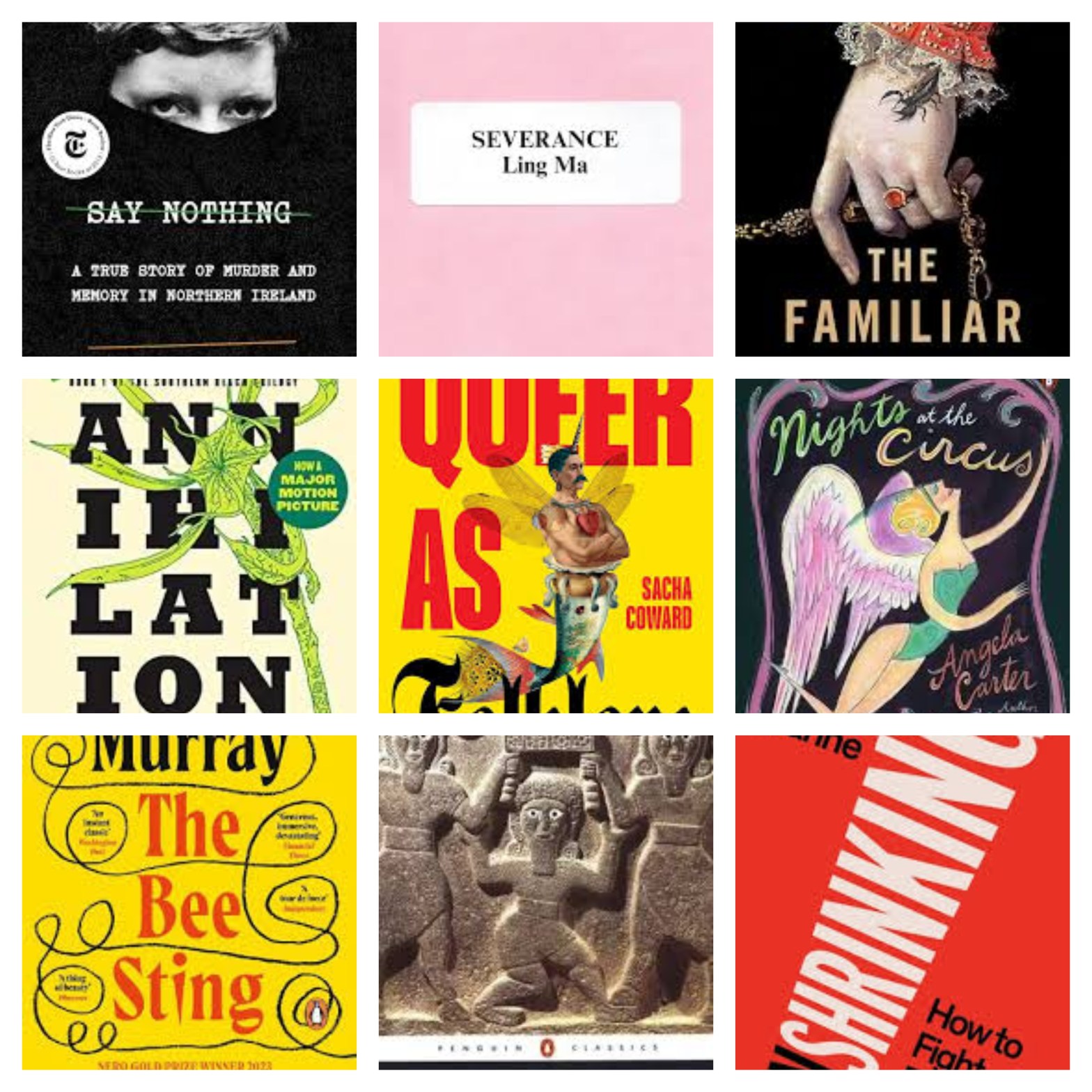
Say Nothing: A True Story of Murder and Memory in Northern Ireland by Patrick Radden Keefe
Sometimes it takes seeing something written out in black and white to fully to fully comprehend its magnitude. Growing up in Ireland, the names Jean McConville and Gerry Adams have always been known to me and I even studied the Troubles in school as part of my Leaving Cert exams but there’s something very different about reading a sanitised version of history in a school textbook and actually reading first person accounts of those who suffered under and conducted acts of terror. For those less familiar with the history of Northern Ireland, Jean McConville was a single mother of ten children who was disappeared by the IRA, who accused her of acting as an informant for the British Army. Although many members of their close-knit community were involved either actively or passively in her abduction, her children went decades without any closure. It is this episode that Radden Keefe uses as a starting point for discussing the sectarian violence that rocked Northern Ireland for years and how ordinary citizens became radicalised and how they justified committing atrocities against innocents under the guise of a war. Going beyond the peace process, Radden Keefe also focuses on the silence and bitterness that still pervades Northern Ireland today over the events of the Troubles and the echoes of trauma that will likely never be resolved. If you want a history book that is both engrossing and meticulously researched that still provides you with a real insight into humanity in extremis, this is a great read.
Leigh Bardugo is one of the author’s whose books I buy without generally even needing to read the blurb, but if I had needed persuading this plot feels designed in a lab to grab my attention. It centres around Luzia, a scullery maid toiling away in fifteenth century Madrid, who is concealing a couple of very dangerous secrets. The first is that she has the ability to do magic and has a tendency to use her ‘little miracles’ to cut herself a lucky break in a world where the sun always seems to shine on someone else. The second is that her magic stems from her Jewish faith and the Ladino phrases passed down from her aunt. If the Inquisition were to get wind of either of these things, let alone both, she’d be headed straight to a fiery death on a stake. When her social-climbing mistress starts forcing her to use her powers to entertain dinner guests, Luzia starts attracting entirely too much attention from the powerful men of Spain. If she is to survive she will need rely on her wits, her strength and a mysterious magical being known as Santangel who says he wishes to help her but may prove her undoing. A lush and gorgeous historical fantasy that manages to feel both gritty and like a fable about the dangers of bargains, Bardugo will be remaining firmly on my list of authors whose grocery lists I would happily read.
While you were working during the COVID-19 pandemic were you ever seized by the eerie feeling that you were like one of the members of the band on the Titantic who continued to play even though the ship was sinking? That you were going through the motions of normalcy in the absence of feeling like you could do anything else? Then you’ll relate to Severance’s protagonist, Candace Chen. As a deadly plague rips through New York City, Candace just keeps on keeping on, heading to her office job, emailing clients and taking pictures of the increasingly ghostly city on her increasingly fraught commute. But even she can’t keep calm and carry on forever and when she links up with a group of survivors and their forceful leader, Bob, Candace needs to think carefully about what it is she really wants and decide whether she is ready to strike out on her own terms. I checked and double checked when this book was written because I couldn’t get my head around that it came out a full two years before the pandemic. I am so glad I didn’t read it during lockdown because I honestly think it would have freaked me out too much but now, with a bit of hindsight, I can appreciate it for the brutal satire of workplace culture and modern malaise that it is.
Queer as Folklore by Sacha Coward
Thank you to NetGalley and Sacha Coward for providing me with an ARC of this book, it was the perfect pride month read. You may have observed that whenever queer people gather in large groups, a preponderance of mythological imagery often follows – be it fairy wings, unicorn horns or mermaid tails. But why is this? What draws the LGBTQ+ community to folkloric imagery? Coward posits that this is not a modern phenomenon but rather that the origins of these stories are themselves inherently queer, in that they deal largely with outsiders, those who exist between two worlds or who have to conceal a part of their identity, but are ultimately imbued with magical or divine auras. Coward takes the reader on a fascinating jaunt through world folklore, from ancient Greece to the modern Marvel blockbuster, and demonstrates the queer origins of so many symbols of magic and power that we know today. Any LGBTQ+ person looking to remind themselves of how inherently magical they are just for being here as well as any fellow mythology nerds should absolutely pick up this book.
Skeleton Song by Seanan McGuire
Skeleton Song is a novella set in the universe of Seanan McGuire’s Wayward Children series, which focuses on the inhabitants of a special boarding school which aims to help children who have travelled to magical worlds readjust to returning to their old lives once their adventures have come to an end. Our protagonist here is Christopher, a young man with inoperable bone cancer who finds both a cure and true love in Mariposa, a world of singing, painted skeletons. Although his fleshiness makes him a freak in their world, Christopher has never felt more at home than he has by the side of the Skeleton Girl, the princess of Mariposa whom he loves passionately. But before they can be wed and Christopher can become a true denizen of Mariposa, he has to be absolutely sure, and magical worlds can be very unforgiving indeed to those who carry doubt in their heart. This was a gorgeous prequel to the main series though I really hope it doesn’t mean we won’t get a full book dedicated to Christopher as he hopefully finds his way back to his Skeleton Girl.
Annihilation by Jeff Vandermeer
A biologist, a psychologist, a surveyor and an anthropologist walk into an isolated and mysterious environment from which no other scientists have ever returned quite the same, if they even return at all. This is not the start of a joke but rather the eerie premise of Annihilation. It’s very difficult to describe what happens in this book due to my fear of revealing spoilers and also because even now I’m still not 100% sure what I just read but suffice to say if you like a bamboozling and tense mindfuck of a novel, you will probably enjoy Annihilation. However, if you like your atmospheric and weird reads to come with at least a dash of closure, this may be one for you to skip!
Nights at the Circus by Angela Carter
I’ve always loved Angela Carter’s short stories so I was super excited to sink my teeth into one of her full-length novels. If you’re a fan of her book of fairy tales or The Bloody Chamber then I think Nights at the Circus is probably also right up your alley. It centres around Sophie Fevvers, a cockney girl with a heart of gold just trying to make her way in the world and who just happens to have wings. Left on the doorstep of a highly progressive brothel as an infant, Sophie goes from living Cupid statue to star attraction at Madame Schreck’s sinister freak show cum bordello to narrowly avoiding becoming a sacrificial offering in a mad wizard’s attempt to attain immortality. When we meet her she is the toast of Europe, having joined the circus and become the world’s most famous aerialiste, and is relating the story of her early life to a sceptical American journalist. Finding himself utterly in love with her, he throws in his lot with the circus and becomes a clown in order to follow her to Moscow and eventually the wilds of Siberia. Although this is a full-length novel, there’s still much of the short story about this book. Carter has crafted a captivating and eccentric cast of characters, each of whom provides an opportunity for Carter to give us an insight into their background. Carter rarely passes up these opportunities but far from making the novel feel disjointed it creates a riotous and rich tapestry of a world that the reader can get lost in. Earthy, messy and sensual, gothic and whimsical in equal parts, I loved this book and think it’s a must read for Carter fans.
The Bee Sting is a story about a family in crisis. After the 2008 financial crash, the Barnes family’s once lucrative car dealership is haemorrhaging money and the strain is causing the already fragile threads holding them together to fray and snap. To a certain extent, every member of the Barnes family is living a lie and is carrying the legacy of copious generational trauma, but the most darkly funny element of this book is how isolated they all are in their own heads, completely immersed in their own issues and blissfully ignorant of the ways in which the people that they should be closest to are also just inches from breaking down. You nearly want to scream at them to just talk to each other and be honest about what’s really going on, but then I remember that this is a story about an Irish family and therefore revert to mentally praising Murray for his realism. Murray gradually unspools a tragedy generations in the making in a way that feels tantalisingly avoidable and yet fated. A magnificent and engrossing character study that will have you simultaneously rooting for the Barneses to get their shit together while also wanting to shake them.
The Epic of Gilgamesh by Unknown
There is something kind of magical about reading a story that’s over four thousand years old. As you’re reading it you can almost hear the ghosts of the millions of people spanning across time and continents who have read and loved it before you. The Epic of Gilgamesh originates in ancient Mesopotamia and is one of the very oldest stories that the human race has. It does not survive intact and my copy leaves ellipses so that the reader can see where certain lines and episodes have been lost to history. However what still survives is more than sufficient to form a story. Our hero is Gilgamesh, a king of Uruk, who is so powerful and superlative that he cannot help but cause havoc in his city. Taking pity on the people of Uruk, the gods create a foil for Gilgamesh, a wild man of the forest named Enkidu. Gilgamesh and Enkidu become inseparable and go on a number of heroic adventures but the story becomes really interesting in its latter half after Enkidu is killed. Gilgamesh is devastated by the loss of his friend and so travels to the very edges of the earth to understand the secret of eternal life. Forced to reckon with the inevitability of death, the story ends with a wiser Gilgamesh returning to Uruk to rule better than he did before. Although this is an unfathomably old story, so much of Gilgamesh’s journey still feels relevant today and its echoes can be seen everywhere from my favourite Greek epics like the Iliad and the Odyssey to modern Marvel superheroes. The text itself can be tough going to those who aren’t used to ancient epic but it’s an incredibly special read that gives a glimpse into the beginning of humanity’s very beginnings.
Unshrinking: How to Fight Fatphobia by Kate Manne
Every now and again you read a book that manages to totally rewire your brain chemistry and, in my experience, those books are usually written by Kate Manne. Manne is a professor of moral philosophy and I imagine she must be a great teacher because she has an incredible talent for taking complex social phenomena and analysing them clearly and accessibly for the average reader. Previously her work has centred around sexism, misogyny and male entitlement, but on this occasion she has turned her attention to the persistent discrimination faced by fat people in our society. Manne deftly demonstrates the systemic nature of fatphobia in her opening chapters but she really gets cooking towards the end of the book when she asks the question of whether or not fat people have a moral obligation to try to lose weight. Her razor sharp annihilation of this way of thinking and her notion of ‘body reflexivity’, which is the idea that your body exists for you and you alone, has really changed the way that I think about and relate to my body. But make no mistake, this is not a book preaching self-love but one that makes an incredibly persuasive case for a radical overhaul of the way our society thinks about and treats fat people. Would that every social movement had a champion as doughty and intelligent as Kate Manne to champion it!
Lady Susan was written when Austen was only in her teens and was published posthumously . This is probably Austen’s least known work which is such a shame because it’s one of her funniest and most subversive. It centres around the vivacious and capricious Lady Susan and if you’re used to your Austen heroines being clever young women with hearts of gold, you may be in for a shock! Lady Susan is freshly widowed but this does not stop her from being single and ready to mingle. In possession of that sort of shallow charm that leaves men dumbstruck and that women can see through in an instant, Susan causes absolute chaos in every home she visits, enchanting young, single heirs and married patriarchs alike. Amongst all this she is also determined to marry off her daughter Frederica seemingly to the most unpleasant man that she can lay her hands on and sully the reputations of everyone within a mile of her location. Lady Susan is a terrible person but more than anything she is terribly entertaining and if you’re the kind of person who’s watching Bridgerton for the Lady Whistledown drama rather than for the love story than this is going to be your favourite Austen book!
The Two Towers by J.R.R. Tolkien
Very few things give me a greater sense of peace than sitting down and reading about my favourite hobbits and their quest to save the world from darkness. No matter what is going on in my life, I can always at least fall back on the fact that I’m not having to trudge through the Dead Marshes to almost certain death (my version of ‘If Britney can survive 2007, you can survive today’). Something about the relentless but hard-won optimism of the story, the way that in spite of all of the difficulties the heroes keep trudging on and believing in the light at the end of the tunnel, the way that even when things seem impossible they choose to go down fighting, really resounds within my soul. It may not be edgy or seem particularly cool when it stands next to some of the more recent favourites of the fantasy genre but this is truly one of the ‘tales that really matter’ and I know I’ll keep coming back to it again and again as I get older.
Emily Wilde’s Map of the Otherlands by Heather Fawcett
Another feel-good fantasy sequel though unfortunately I can’t say I enjoyed this one as much as I enjoyed its predecessor. The cosy, light academia vibes still abound which makes this a perfectly charming comfort read however the plot was less tightly structured than the first book in the series, sometimes leaving me feeling as if we were wandering as aimlessly as Danielle de Grey herself. Some of the newer characters felt a bit shoehorned in as means to allow Emily to continue to show her emotional stuntedness/growth but didn’t quite feel like fully realised people with desires and motivations of their own (*cough* Ariadne *cough*) but it’s possible there’s more to come from them in future books. I also found the climax of the novel in which Emily finally accesses the Otherlands to be a bit…anticlimactic. I felt like I blinked and it was over and frankly after all of the build up around Wendell’s stepmother I was expecting her to be a bit tougher! Unfortunately I think this has a bit of a case of ‘middle book syndrome’ wherein the author needs to progress the plot from the first book which introduced us to the characters and the world we all know and love while still leaving scope for the main climax and resolution of the plot in a book that is yet to come. It’s a tricky balance to make this bridge compelling and while Fawcett does a good job, unfortunately this sequel doesn’t quite live up to the promise of the original for me.
 Kindled Spirits