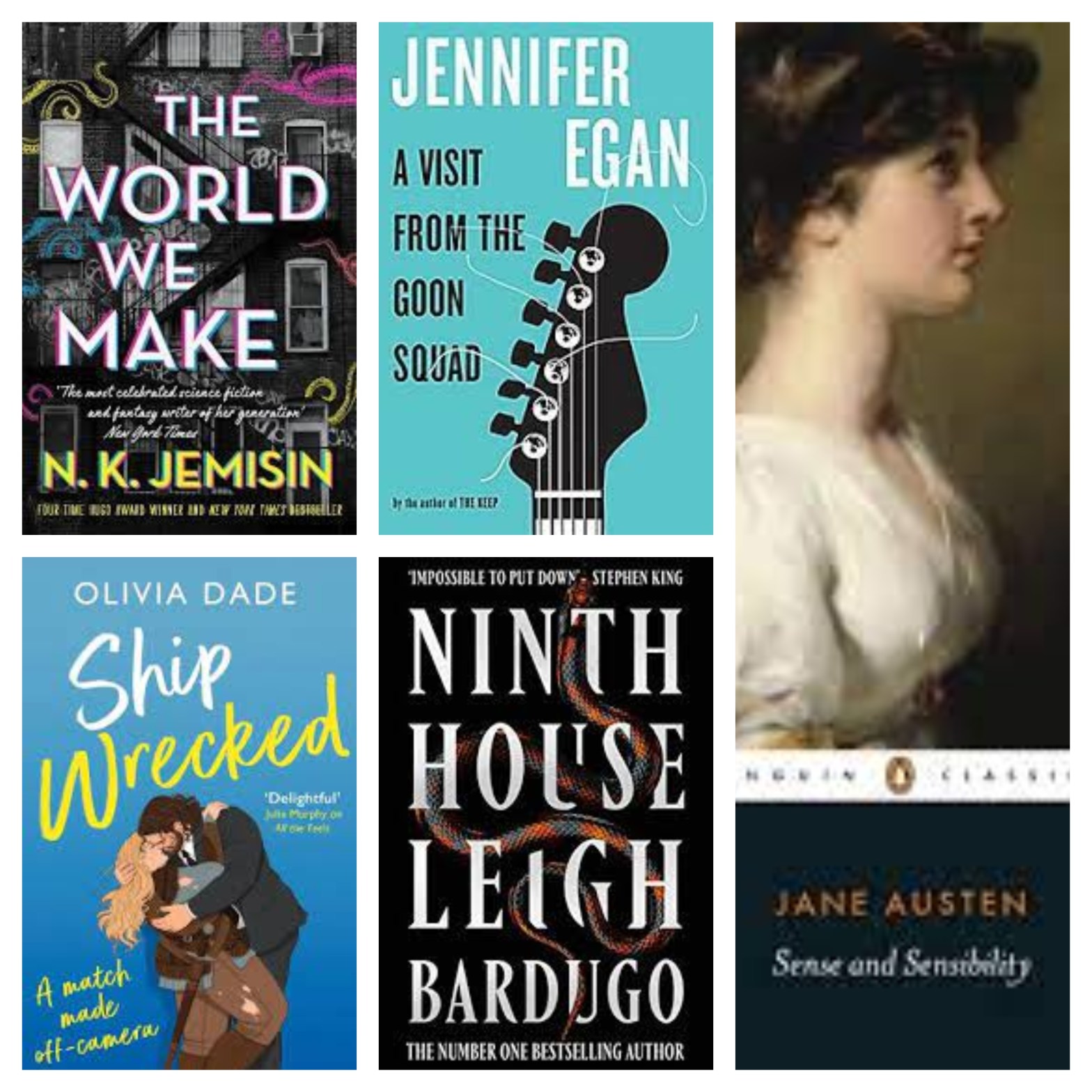
My Month in Books: March 2024

The Priory of the Orange Tree by Samantha Shannon

If you love epic fantasy and strong female characters, you need to get yourself a copy of The Priory of the Orange Tree ASAP. It weaves together multiple narratives that span continents to tell the story of a world divided between those who loath and fear dragons in the West and those who worship and fight alongside them in the East. In the West, Queen Sabran Berethnet’s bloodline has ruled for a thousand years and is believed to be essential for keeping the dreaded Nameless One, the most fearsome dragon of them all, at pay. Protecting her from assassins is Ead Duryan, a lady in waiting who is much much more than she seems. Meanwhile in the East, a young orphan, Tané dreams of being a dragon rider but a chance encounter with an outsider on the eve of the most important day of her life will set in motion a chain of events that will determine the fate of the world. I shall say no more and leave you to the pleasure of unravelling these stories for yourself. Massive in scale with absolutely immaculate world building, Shannon has crafted an epic that feels like an instant classic. Can I also just say how refreshing it is that this is a standalone fantasy novel? It feels like these are an endangered species nowadays. Too often I have been put off cracking open a new fantasy book because I simply cannot afford to commit to another massive series (looking at you Wheel of Time) so thank you Samantha Shannon for making this an easy book for me to say yes too! But thank you also for writing another novel set in the same universe which I may or may not have already got loaded up on my Kindle. Here I go again…

Crying in H Mart by Michelle Zauner

WARNING: Do not attempt to read this book without a steady supply of tissues and comfort food within reach. Zauner, who you may know from her band Japanese Breakfast, has focused her memoir on her relationship with her Korean identity, which she largely connects with via her mother and food. When her mother is diagnosed with terminal cancer, Zauner is forced to reckon with how she sees herself and embark on a journey develop her own relationship her identity through love and acceptance of herself, her mother and her mother’s family, cooking and language. This is a heartbreaking story of grief, mourning the loss of a parent as well as a sense of alienation from yourself and your wider society but it is also a gorgeous and heartfelt love letter to Zauner’s mother and all of the gifts and love that she gave to her daughter. The descriptions of food in this novel are also so mouthwatering that as you’re crying, you will definitely also have an uncontrollable urge to go and wander around your local Korean grocery store and stock up on kimchi.

The Master and Margarita by Mikhail Bulgakov

The Master and Margarita’s absurdist and surreal depiction of life in 1930s Moscow was so accurate, and therefore controversial, that it could not be published during the author’s lifetime. The story has a number of offshoots and diversions but the unifying thread is the arrival of Satan and his minions in Moscow and the havoc that they wreak on the unsuspecting citizenry. Ultimately I did enjoy this novel and found it very entertaining but I couldn’t help but feel as if there were several dozen layers of humour and subversion I was missing by not having a degree in Russian history and culture. If you do have that knowledge, definitely pick this book up because you’ll probably love it even more!

Mislaid in Parts Half-Known by Seanan McGuire

The Wayward Children series always delivers and Mislaid in Parts Half-Known is no exception. This instalment picks up right where Lost in the Moment and Found leaves off, with Antsy having just arrived at Eleanor West’s Home for Wayward Children, where children who have travelled to magical worlds beyond our own can learn to readapt to their old lives. Antsy however, can’t stop thinking about how the denizens of The Shop Where Lost Things Go literally stole her childhood and how they might be doing the same thing to another child as she sits alone in a classroom trying to catch up on school work. When some of her fellow students seek to take advantage of her talent for finding things, she is forced to flee the school with some of our favourite heroes in tow (Kade, Christopher, Cora and Sumi are back!) and since she’s on an unauthorised quest already, this seems like as good a time as any to revisit The Shop and take care of her unfinished business. This was a rollercoaster ride through worlds that also hit me right in the feels, as these books always do. I’m already excited for the next one and I’m hoping that the events of this book have opened a door for Kade to make a triumphant return to Prism and conquer it as the Goblin Prince he was born to be!

Emily Wilde’s Encyclopaedia of Faeries by Heather Fawcett

With goblins on the brain, it only made sense to crack open Emily Wilde’s Encyclopaedia of Fairies. In a world where the existence of faeries is an accepted, albeit mysterious, fact of life, it is therefore natural that an entire field of academic inquiry would spring up to study them. Enter Emily Wilde, one of the world’s foremost ‘dryadologists’, whose life’s work is the writing of a definitive encyclopaedia of faerie life. She just has one more species she needs to study in the field before her book is published and so she sets off to the icy and inhospitable Ljosland to learn more about their mysterious Hidden Folk. But while Emily is a genius in her field and a meticulous researcher, she is somewhat lacking in the social graces necessary to win over the hardscrabble locals whose co-operation will be essential to completing her fieldwork. Enter her wildly charismatic academic rival and sort of friend, Wendell Bambleby, who is all too happy to charm the villagers in exchange for borrowing some of Emily’s credibility after an academic scandal has sullied his reputation. But Bambleby has secrets to rival those of the Hidden Folk and as Emily is pulled deeper and deeper into the strange world of the local fae, she is forced to reckon with something even more complicated than magic and fairy politics combined…emotions. A thoroughly charming and light-hearted read. If you loved the tone of Jonathan Strange and Mr. Norrell but are looking for something that’s a bit more accessible, this is perfect.

My Month in Books: February 2024

A Conjuring of Light by V.E. Schwab

A Conjuring of Light was going to go one of two ways; either it would live up to the promise of A Darker Shade of Magic or fall into the same traps of cliche and loose plotting that caught its predecessor, A Gathering of Shadows. Disappointingly it was the latter. All of the basic bones of a really good story were there but Schwab seemed to keep getting distracted, adding in chapters from perspectives of characters I frankly didn’t care about and who hadn’t played a major role in earlier books (sorry Emira, it’s way too late for you to try to be interesting), flashing back to events that happened before the series even started and didn’t really have any impact on what was happening in the present (you cannot make me give a shit about Holland and his woobie backstory) and tossing in chunks of political intrigue that distracted from the central plot (all the assassination stuff made no sense). Don’t even get me started on the deus ex machina/fetch quest combo that did eventually save the day but suffice to say if your heroes defeating the bad guy hinges on a random magical item of profoundly hazy origins that we are hearing about for the first time two thirds of the way through the final book in a trilogy, it just feels like lazy plotting. The real thing that ruined this book for me though is the character of Delilah Bard. As much as I hate shitting on a female character and slinging around accusations of Mary Sue Syndrome, I hate characters who exist more or less entirely to say allegedly bad ass quips and do profoundly stupid things due to their seriously overinflated sense of confidence more. Shades of Magic, I gave you a fair shake but you’re definitely not for me.

Good Material by Dolly Alderton

Dolly Alderton is an author who I feel like is known for her specific insight into young women and their romantic relationships, so I was intrigued to see that she’d be stepping out of her comfort zone for her latest novel, which is told from the male perspective. Our protagonist is Andy, a struggling stand-up comedian in his early thirties who has just been dumped by Jen, the woman he thought was the love of his life. Thrust out into the cold of singledom, Andy finds himself spiralling into obsession as he tries to understand why Jen broke up with him so suddenly. This book was a witty and empathetic exploration of modern masculinity and the ways in which it can leave men feeling empty and lost without female support. The pathos of Andy’s emotional journey was well-balanced by some truly spectacularly cringeworthy bathos that kept the novel light and readable. I must say though, the last fifth of the book when Jen takes back the mic and gives us some insight into her mindset and why she really broke up with Andy was where the novel was strongest. I love that Alderton branched out to try something new and I think she was definitely successful at capturing the male perspective, but she clearly knows her strengths are in writing what she knows and she is an author who knows women incredibly well.

Fourth Wing by Rebecca Yarros

I’m bracing myself for torches and pitchforks because it seems like everyone on the internet is in love with this book but it is definitely not for me. On the surface, Fourth Wing is a pretty standard romantasy novel starring Violet Sorrengail, a fragile little lady who just wanted to grow up to be a scribe but because her mum wants her to die I guess (?) she’s told she has to go to a school with a very high fatality rate to learn to ride dragons and fight on the front line of a war instead. It’s not just that the central romance is cliched and you can spot the alleged plot twists coming from a mile away (who would have ever guessed she’d fall in love with the incredibly attractive man who she’s been told to stay away from? And that maybe is not all that it seems with the war that senior leadership are constantly lying about?), it’s that the fantasy world-building is just shite. What time period is this meant to be taking place in? There’s no modern medicine but characters refer to indoor plumbing and playgrounds? Can Yarros please take five minutes to give some indication of how this world became the way it was? But maybe I should be careful what I wish for because when exposition did happen, it felt beyond clumsy (though to be fair, who among us hasn’t started reciting the history of our country in stressful situations? I know when I’m faced with a problem the first thing I do is check I can remember who the Prime Minister is and identify Britain’s biggest trading partners!). And what we do know doesn’t make any sense! You’re at war and in desperate need of dragon riders but you won’t stop encouraging all of your dragon riders to kill each other? Even when they’ve done the hard bit and actually been bonded to a dragon? And you’ve potentially invested years in training them? Someone needs to call the leadership of this army and institute a more effective staffing strategy. Last but not least, the dragons. I love me a dragon. No matter what fantasy world you’re living in, dragon’s are always mysterious, powerful and profoundly magical and so I was intrigued by the premise of dragons who are bonded to human riders. But tragically, two things let the dragons in this book down. The first was the fact that our heroine gets not one, but two, bonded dragons because she’s just so gosh darn super special but I felt this really degraded the idea of dragons and their human having a deep and special connection. The second was the way the dragons ‘talked’. As I said, I’m used to dragons being powerful and magical so imagine my disappointment when they finally started speaking in Violet’s head and started making sassy little quips. There was no danger, no sense of awe and the dragons just lost all sense of mystique for me. For me, this book was style over substance, a decent idea with terrible execution, and I will die on this hill.

Boys & Sex by Peggy Orenstein

Boys & Sex does exactly what it says on the tin. Author Peggy Orenstein interviewed hundreds of young men from across the United States to understand their perceptions of masculinity, sex and intimacy. This is a truly eye-opening piece of non-fiction which shines a light on a range of difficult to discuss topics from ‘locker-room banter’ to hook-up culture and consent to pornography to emotional vulnerability. I was amazed at how open and candid Orenstein’s subjects were with her and how eager they were to have these conversations. Overwhelmingly I was left with the feeling that boys were being failed by the conventional assumption that they don’t want to discuss their feelings and only want to have sex with no intimacy attached. These young men were crying out for someone to help them understand their emotional needs in a non-toxic way and my heart went out to them. This book is an incredible advertisement for the importance of sex and relationship education and the better world that we could build if we were just open and honest with young people about sex, love and intimacy. This is a must read for anyone looking to better understand a young man in their life.

Girls & Sex by Peggy Orenstein

Naturally having found Boys & Sex so enlightening, I had to turn to Girls & Sex next to get the full picture. Here as well Orenstein has interviewed young women from across the United States, looking to understand their attitudes to sex and desire. You won’t be surprised to know that the focus here winds up being different to that of the young men, with a strong emphasis on the ways in which young women are sexualised from an early age. What I found most remarkable about this book was the revelation that most women tend to measure how ‘good’ sex is by how much their partner enjoys it and by how desirable they feel rather than whether or not they’re actually experiencing desire or pleasure themselves. A truly stunning number of these girls seemed baffled by the idea that sex should feel good to them and their pleasure should be a priority for their sexual partners. Funnily enough though, this didn’t apply when Orenstein interviewed young queer women! Once again, this book is a compelling argument for young people receiving detailed sex and relationship education that centres on respect for your partner and actual pleasure rather than just the mechanics of putting a condom on a banana. A compelling read for anyone looking to better understand the world of female sexuality – be it your own or that of someone you love.

Equal Rites by Terry Pratchett

In my quest to read all the Discworld novels in order, I have been waiting with bated breath for the introduction of the witches, my favourite characters in the series. As always, Granny Weatherwax does not disappoint! In Equal Rites, she is a mentor to Esk, a young woman who has accidentally inherited the abilities of a powerful wizard. Now in the Discworld, witchcraft and wizardry are two quite distinct disciplines, with witchcraft focusing on practical applications of magic to the real world and is practiced exclusively by women, and wizardry being much more about the theoretical and intellectual study of magic and is practiced exclusively by men. So naturally, a female wizard is causing quite a lot of problems and confusion. But with Granny Weatherwax to escort her to the Unseen University, the centre of learning for all wizards, how could Esk possibly put a foot wrong? Er quite a lot of ways actually but as ever the joy of Pratchett is the journey rather than the destination and watching him cheerfully skewer both fantasy and gender stereotypes was an absolute pleasure.

Death Valley by Melissa Broder

Melissa Broder novels may not be for everyone but they are definitely for me. If you’re looking for a novel that is simultaneously a profound meditation on grief, sickness and what it means to love and care for someone, a darkly funny psychedelic vision quest through a mystical cactus and a passionate love letter to Best Western and its employees then this is the (only) book for you. Is this book absolute bonkers? Yes. But is it emotionally true and meaningful? Also yes. Surrender to the cactus and go along for the ride.

Glorious Exploits by Ferdia Lennon

Sometimes you read a description of a novel and you feel like it was written for you so huge thanks to Netgalley and Penguin for giving me an ARC of this book. It takes place in the aftermath of the failed Athenian invasion of Sicily in 412 BCE, when thousands of Athenian soldiers were held captive in the island’s quarries and left to die. Lampo and Gelon are two local men, best friends with not much going for them since the pottery factory they were employed in was destroyed during the war. However, Gelon is a passionate fan of Athenian tragedy and so they spend their days going down to the quarry and offering scraps of food to any Athenian who can recite a few lines of Euripides. Eventually an idea takes shape, why not use the Athenian prisoners to stage a real Athenian tragedy in Sicily? Can hate be put aside for a communal experience of emotion and art? Glorious Exploits is a highly original whirlwind of a novel that deals with themes of war, grief, divinity and slavery while still being hysterically (in the original sense of the word) funny and cathartic. For me it truly captures the essence of ancient tragedy, the devastation and the ecstasy, the hope and the audacity, the knowing how it will end and praying it will end differently. Whether you’re a hardcore Euripides fangirl like me or you’re new to ancient tragedy or you just like a really bloody good story, this is for you.

Norwegian Wood by Haruki Murakami

Norwegian Wood is a classic coming of age novel set in 1960s Tokyo. Our protagonist, Toru, a quiet and self-contained university student, is torn between two very different young women. Naoko is the beautiful, troubled and otherworldly girlfriend of his childhood best friend who died by suicide when they were teens. While Toru is passionately devoted to her, her fragile mental health requires to convalesce in a specialised facility that lets her live a life of near perfect tranquility. Although he visits her when he can and writes to her often, he cannot help but be drawn to Midori, a fellow student. Midori is chaotic, loud, brash and dealing with her grief for her recently deceased mother while caring for her extreme ill father and running her family bookstore. While Naoko is like a perfect work of art frozen behind glass, always beautiful but never growing or changing, Midori is real and present and messy. As Toru grows from a child into a man, he must reckon with what it means to truly love someone and to truly live. A gorgeous, ethereal novel that can feel bleak at times but ultimately shines with a passionate lust for life.

Teddy by Emily Dunlay

Thank you to Netgalley and Fourth estate for this ARC. Teddy is propulsive page-turner about a woman on the edge of reason in 1960s Rome. A Texas socialite with a past shadier than she’s willing to admit to, Teddy is thrilled when she finally meets a man willing to propose. Sure her new husband seems like a bit of a stick in the mud, but his work for the State Department will take her to the glamorous heart of the Eternal City, where she can finally leave her past behind and be the ideal version of herself, a perfect diplomat’s wife. This lasts about five minutes. Desperate to stop her shiny new life shattering into pieces, Teddy must reckon with Russian spies, sleazy politicians and sneaky paparazzi all while keeping up appearances with a husband who she doesn’t know nearly as well as she thought. This is a perfect holiday read that combines the excitement and charm of the Cinecittà with the uneasy tension of a woman trying to cram herself into the narrow box of respectability for women in the 1960s.

My Month in Books: January 2024

The Iliad by Homer, translated by Emily Wilson

One of my favourite gifts that I received this year for Christmas is this new translation of The Iliad by Emily Wilson. The Iliad is a poem I have spent huge chunks of my life studying and obsessing over but it had been a long time since I last kicked back and read it purely for pleasure. For those who aren’t aware, The Iliad tells the story of a handful of days towards the end of the Trojan War, in which Greek soldiers are fighting to secure the return of Helen, the most beautiful woman in the world, who has been stolen away from her Greek husband, Menelaus, by Paris, a Trojan prince. The real focus of the poem however, is Achilles, the greatest of all the Greek warriors who knows he is doomed to die young and so must take every possible opportunity to secure his legacy as a hero and ensure his glory is sung of throughout the ages. When he is disrespected by the Greek commander, Agamemnon, Achilles withdraws his services from the Greek army and resolves to sulk in his camp until his honour is restored. This incident kicks off a chain of events that will see countless Greek and Trojan warriors die, including Achilles’ beloved Patroclus, before Achilles returns to the battlefield to take his terrible vengeance on the Trojans. But what always moves me so much about The Iliad is that the poem ends not on a scene of triumph or bloody revenge, but in a scene of forgiveness and mourning, as Achilles lets go of the destructive force of his anger and agrees to return the body of his greatest foe, Hector, to his father, Priam, the king of Troy, fo burial. As the women of Troy mourn their city’s protector, I always get a little shiver thinking about how all of the figures in this poem have been dead for thousands of years and yet here I am feeling for them, their kleos still resounding after all this time. Wilson as a translator really draws out the themes of impermanence and grief from this poem. Her choice of iambic pentameter as a meter is an excellent one which honours the oral history of the poem and draws the reader along at an invigorating pace, even through the infamous catalogue of ships. Her translators notes are also fascinating and the absolute nerd in me loved getting a glimpse behind the scenes as she offered context to the choices she made while translating. This edition is a classicist’s dream and was a perfect start to my reading year.

Prophet Song by Paul Lynch

This was an absolute gut-punch of a novel and once I finished it I had to spend at least twenty minutes staring at the ceiling just processing. It centres around Eilish, an Irish everywoman type who splits her time between work, raising her four children alongside her husband Larry and caring for her father who is slowly losing himself to dementia. However, her life is turned upside down the day that Larry doesn’t come home from a protest against the government that he was leading as part of his job as a trade union organiser. Things have changed in Ireland recently and as the emergency powers brought in by the new government to manage upheaval are starting to look increasingly permanent, anyone who seems to oppose to the government is starting to vanish into thin air. No one will tell Eilish where her husband is and as the country slides farther and farther along the path to totalitarianism and civil war, Eilish fights desperately to keep her family together and hope alive. But the authoritarian forces that are now in control of Ireland are inexorable and as her family disintegrates around her, Eilish is faced with an impossible choice, should she stay and fight for the life she once had or should she flee to safety with as much of her family as she can take with her? The prose style is gorgeous but does take a little while to get used to. However, once you’ve adjusted, it really adds to the sense of denial and unreality that Eilish is experiencing. A fantastic read though be ready to be devastated.

The Well of Ascension by Brandon Sanderson

Think defeating the Lord Ruler was hard? Try actually ruling over the fractured remains of his Empire. The second book in the Mistborn trilogy picks up one year after the end of The Final Empire as Vin, Elend and the rest of the crew struggle to maintain control over Luthadel with a newly-created people’s assembly vying for power, a cult springing up around the myth of Kelsier and Vin and multiple armies sitting on their doorstep looking to conquer the city. On top of all of these threats, the mist has started behaving very strangely indeed, with it starting to linger even as the sun rises and perhaps even killing people. With all of this chaos, Vin cannot stop thinking about the Lord Ruler’s final warning that killing him would unleash something truly terrible upon the land. Is this the Deepness coming back? And if so, does that mean a new Hero of Ages needs to rise up to stop it? I really love that even with all of this going on, Vin is still 100% an awkward teenage girl who is also very stressed about what clothes she should or shouldn’t be wearing and whether her boyfriend is too good to be true. And the twist at the end? Insane. And the OTHER twist? Breathtaking. I’m having to really work to pace myself on this series. Another stunningly beautiful, compulsively readable and perfectly constructed fantasy world from Brandon Sanderson.

Trick Mirror: Reflections on Self-Delusion by Jia Tolentino

I have already discussed my feelings about this book at length here on my blog but sometimes a book calls to you to be reread. Trick Mirror reached out to me late one night as I lay in bed staring at the ceiling with my brain firing on all cylinders. I was in typical January ‘new year, new me’ mode, obsessing about how I should be eating better, exercising more and maybe using retinol to fix my face. As I stared into the abyss, I could almost here this book whispering to me to come pick it up and so I did, reading Always Be Optimising, an essay which explores the cult of self-improvement and optimisation that is shoved down the throat of anyone with an Instagram account. Having been reassured of my sanity and determined to spite the capitalist machine out to exploit my anxiety, I drifted off to sleep. I spent the next few days rereading the whole book and it remains a tonic for tricky times. This is a book I know will always be there for me when I need it.

Welcome to the Hyunam-Dong Bookshop by Hwang Bo-reum

I need cosy little slice-of-life stories about bookshops gently healing people injected directly into my veins. Welcome to the Hyunam-Dong Bookshop is a Korean novel which centres around Yeongju, formerly a high-flying career woman with an equally ambitious spouse, currently an independent bookshop owner trying to make a new start in life after quitting her job and getting a divorce. Initially burnt-out and unable to stop crying, slowly but surely Yeongju settles into the new slower and more deliberate pace of her life, reading voraciously and mulling what makes a great bookshop. As the shop begins to find its place, it attracts others who are at a crossroads in their life and looking to make changes, from the disillusioned barista, to the grumpy sales clerk to the quiet customer who comes in every day to knit in the cafe. Slowly but surely, these characters find the strength to take little steps forward and lean on each other in a world where the rat race can seem all-encompassing. If life is all feeling a bit much right now and you need some gentle reassurance that whatever you’re doing is A-OK, this is for you.

How to Sell a Haunted House by Grady Hendrix

I’m usually an absolute wuss about all things horror, but I will always make an exception for Grady Hendrix novels because his ideas are so off-the-wall and the fear factor is offset by a dark sense of humour and real emotional depth. How to Sell a Haunted House is another fine example of this. It centres around Louise Joyner, a single mum who has just received the news that both of her parents have been killed in a sudden car accident. Having always been the responsible one, Louise now has to fly back home to take control and make arrangements lest her perpetually feckless brother Mark manage to screw things up. But death has an awful way of bringing people closer, especially when your childhood home is haunted by homicidal puppets. You see when Louise’s mother was alive, she was a prominent member of the Fellowship of Christian Puppeteers, spreading the gospel through puppet shows, and their family home is bursting with all of her various puppets, dolls and taxidermy projects. So basically the house was a horror show before anyone died. But now that her mother isn’t there to keep an eye on her most rambunctious and cursed creations, clearing out the house to sell it is definitely a two man job and the siblings must put aside their differences to finally put their family ghosts, both literal and figurative, to rest. While the premise is nuts and there are plenty of scares to satisfy the horror lovers, lurking just beneath the surface is a really quite touching story of healing from generational trauma. However, if you find puppets even remotely creepy and you want a good night’s sleep? This book is not for you.

My Month in Books: November and December 2023

Why We Get the Wrong Politicians by Isabel Hardman

I spend a lot of my time at work thinking about the UK’s political system (and to be honest way too much of my free time as well) so I was excited to get a slightly more outside perspective on the workings of Westminster. While the book is probably a little bit basic for hardcore politics nerds (though I was thrilled to see a whole section dedicated to the wonderful world of secondary legislation!), it’s a perfect entry point to the UK’s political culture for those who have wisely spent their time avoiding the BBC homepage. Taking the reader on a journey through the shadowy world of MP selections, elections themselves and then the actual process of lawmaking, Hardman is thorough while still remaining readable and accessible. For anyone who’s looking to get their head around what the hell is going on in Westminster in the run up to this year’s election, this is a great place to start.

Lost in the Moment and Found by Seanan McGuire

Even by the standards of the Wayward Children series, Lost in the Moment and Found emotionally ruined me. Our heroine is Antsy, a young girl who has fallen through the cracks. After her father’s sudden and tragic death, her mother quickly remarries a man who seems more interested in exploiting rather than helping the vulnerable child whose family he has muscled his way into. After a disturbing encounter with her stepfather, Antsy knows she has to get out fast or something terrible will happen to her. She packs up her backpack and runs away from home, only to stumble into the Shop Where Lost Things Go, a magical pocket dimension that exists between universes and seems to attract the lost and the forgotten. Surrounded by treasures and magical doors that open into an infinite number of new worlds, Antsy is quickly able to banish thoughts of her family to the back of her mind and lose herself in her new adventures. However, all magic comes with a price and, once again, the adults in the room are not looking out for Antsy’s best interests. This is a heartbreaking, albeit hopeful, novella about the loss of childhood innocence, the cycle of abuse and what it takes to break free from it all wrapped up in a magical package. Seanan McGuire has definitely done it again.

Once, Twice, Three Times an Aisling by Emer McLysaght and Sarah Breen

Sometimes after reading something heavy, you just need to throw yourself back into a familiar world that you know will make you smile. For me, the Oh My God, What A Complete Aisling series always delivers on the feel good vibes. Aisling represents a very specific type of Irish woman, the girl who has moved to Dublin for work but who travels ‘back home’ to the countryside every weekend to check in on her parents and to see her long-term boyfriend who plays on the local GAA team. The sensible friend who would look on in horror at anything that could be considered ‘notions’. Aisling’s come a long way since the start of the first book and although now she’s a successful business owner, swimming in friends and having her very first casual relationship, she still feels completely overwhelmed. As she turns thirty, she’s grappling with not feeling quite enough and is overcompensating by saying yes to absolutely everything, from giving her best friend the hen party of the century, to catering a celebrity wedding and even *gasp* moving in with a man. Hilarity ensues but also some genuinely sensitive handling of mental health issues and burn out. A perfect light read for heavy times.

Crossroads by Jonathan Franzen

Crossroads is a stunning family saga very much of the ‘white people with no real problems creating problems for themselves’ genre of prestigious literature. You have patriarch Russ, a pastor who’s bummed that the kids at church don’t think he’s cool and copes with his midlife crisis by pursuing an affair with a parishioner, and his wife, Marion, who has lied to everyone in her life about her traumatic past and mental health issues and is on the brink of falling apart. Their children, Clem, Becky, Perry and Judson, are respectively trying to get themselves drafted into Vietnam following a sexual awakening, accidentally having a religious awakening while trying to steal another girl’s boyfriend, selling drugs to children while also becoming profoundly addicted himself and too young to be relevant to the plot. The novel is a pretty intense psychological study of each of the characters and is bursting with religious guilt, shame and questions of morality. Pick up this one for beautifully written musings about what it means to be a good person, not for a rip-roaring plot. Franzen has said that this will be the start of a trilogy and I’m fascinated to see where he takes it next.

Toxic: Women, Fame and the Tabloid 2000s by Sarah Ditum

The 2000s were not all that long ago, but reading the book is felt like reading about another planet. A world of upskirting paparazzi, vicious tabloid gossip blogs and stolen celebrity sex tapes, it represents a period where the internet truly was the Wild West and the boundaries between the world online and the real world were still being figured out. This was a fraught time to be dealing with fame and doubly so if you were female. Ditum examines the misogyny of this time period through the lens of the treatment of some of the era’s most famous women, including Britney Spears, Paris Hilton, Lindsey Lohan and Amy Winehouse. This was a fascinating insight into 2000s tabloids culture (which blessedly I was a bit young and sheltered to be too into at the time) but also a tragic tale of complex, talented and interesting young women who were victims of a cannibalistic media model that profited off their pain and revelled in their downfall. An engaging, easy read that will really make you think about the culture that millennial women came of age in.

Oranges Are Not The Only Fruit by Jeanette Winterson

I am slightly embarrassed that it has taken me this long to crack into this queer classic but I am thrilled to say that it absolutely lived up to the hype. Oranges Are Not The Only Fruit is the story of Jeanette, a young women adopted and raised by her extremely zealous mother to be one of god’s chosen children and a missionary. Jeanette is a true believer and is passionate about her faith but it all goes slightly awry the day she falls for one of the young women that she has converted. Unable to repress who she truly is, Jeanette is forced to leave her family and her church in order to pursue love and fulfilment. Winterson’s prose is so original, vivid and funny while still packing an emotional punch. I can see why this has been such a beloved book for so long and I’m delighted I’ve finally gotten to experience it.

Divine Might by Natalie Haynes

There are few things I will run out and buy faster than a new Natalie Haynes book. Her passion for the ancient world is evident in every word she writes and her keen wit and sharp eye for the intersection of the world of myth with our world really brings the stories to life for a new audience. Her latest book is a non-fiction collection of essays, with each one centring around a different Greek goddess, from the well-known ones like Aphrodite and Athena to the slightly more niche ones such as Demeter and the Furies. I really enjoyed her fresh perspective on these well-loved goddesses, reading this book felt like having a (to be fair, pretty one-sided) chat with a best friend whose as passionate about Greek mythology as I am. Whether you’re a verified Classics nerd like me or a newcomer to Greek mythology who’s looking to learn more, Haynes’ work is a joy.

Battle Royale by Koushun Takami

What does it say about me that this book is one of my favourite comfort reads? When my brain is short-circuiting, nothing calms it down quite like the relentless, high-octane bloodbath of forty-two high school students trapped on an island and forced to kill each other or be killed. Before you say this rips off The Hunger Games, 1) Battle Royale was published nearly ten years earlier, you philistine and 2) it’s even more fucked up because in The Hunger Games most of the tributes were strangers to each other, whereas in Battle Royale the competitors are all members of the same high school class and have years of history, friendship, crushes and grudges between them. The potential for tragedy and betrayal is endless. Our story centres of Shuya Nanahara, a young musician determined to honour the death of his best friend by protecting Noriko, the girl his friend had a huge crush on, but the novel is bursting at the seams with the individual stories of each of the forty-two students. Whether they appear for just one chapter before being killed off or whether they fight on for longer, the reader is given a glimpse into who this person really is as they are pushed to the very edge of their sanity and morality. The key question at the heart of this book is about what it means to trust someone and the horrifying consequences of either trusting the wrong person or, often worse, not trusting the right person. When the stakes are this high, a single moment of weakness can be the difference between life and death and while this book is a pulpy, campy clusterfuck in the best way possible, I also believe in my heart that is has something real to say about humanity, the best and the worst of it.

The Poppy War by R.F. Kuang

Screaming. Crying. Throwing Up. This is what The Poppy War did to me and I don’t know when I will be normal again. The story centres around Rin, a young war orphan living in the an isolated backwater of the Nikara Empire. Her foster family see her as being good for nothing more than being married off to a wealthy man old enough to be her grandfather. Rather than resign herself to a loveless life of drudgery, she resolves to pass the Keju – the famously difficult Empire-wide exam to identify the best and brightest to be trained at the Academies. Not only does she pass, she aces it, gaining acceptance into Sinegard, the most elite military academy in Nikan, where the Empire’s future top generals and strategists are made. But Rin’s troubles are only beginning. A poor, dark-skinned girl with no family connections and none of the advantages of her classmates is not exactly welcomed with open arms by the Academy and she has to force herself to be twice as good to get the same respect as her peers. When she unlocks an unprecedented, divine power within herself, she quickly becomes impossible to ignore and with war bearing down on the Empire from the Federation of Mugen, she and her classmates will very quickly have to put their lessons to the test. As they leave the classroom and face real combat for the first time, it becomes apparent that the reality of war is very very different from the theory and that there is nothing that their enemies won’t do to see them eradicated. Sacrifice will be necessary to defeat them, but how much is Rin willing to sacrifice for the power to save her people? And how much of herself will she lose to the Phoenix inside of her who is hungry for destruction? Rin is truly one of my favourite fictional characters and I was rooting for her and her success so hard throughout the book, I really had to catch myself to stop myself from cheering on straight up war crimes. But I support women’s wrongs as well as women’s rights so for me this book is an absolute triumph.

The Dragon Republic by R.F. Kuang

This series was completely unputdownable so naturally I ran straight for The Dragon Republic after I finished The Poppy War. After defeating the Mugenese, Rin is addicted to opium and crippled by guilt and PTSD. She needs allies but they’re pretty thin on the ground apart from an old frenemy from her days at Sinegard. Nezha, never really one to judge someone for their more ruthless instincts, recruits her to the cause of the Dragon Warlord, who is aiming to take advantage of the chaos of the aftermath of the war and unseat the Empress and create a new Republic. United by their mutual hatred of the Empress, Rin throws herself into this new cause and works to get the power of the Phoenix under control. But as doubts begin to creep in about the purity of the Dragon Warlord’s democratic intentions, coupled with his worryingly one-sided alliance with the Hesperians of the West, Rin slowly begins to suspect that Nikan’s future lies elsewhere. Another grim and epic tale of gods, monsters and a bloody and gruelling war with an absolutely heart-stopping and soul-shattering ending (WHY?). Once again R.F. Kuang has ruined my life.

The Burning God by R.F. Kuang

I almost never read an entire series in back to back (last time it happened was with the Grishaverse and I’m still not capable of being normal about that one) but I’m pretty sure the pages of this book were made of crack because I literally couldn’t stop myself. Rin, my favourite war criminal who needs therapy so so much, has gone what could only be described as fully feral after Nezha’s betrayal and she is out for vengeance at any cost. Disillusioned by the Empress and the Dragon Warlord, Rin realises that it’s time for her to reconnect with her Southern roots and lead an uprising of ordinary Nikarans that will shake the aristocracy to its core. With an army who revere her as a goddess at her side, she is ready to finally be the master of her own destiny and finally give the people of Nikara the freedom to be their own masters by banishing the colonizing Hesperians from their shores for good. But what will be the price of total victory and is it one that her pride and bloodlust will let her pay? A profoundly satisfying if devastating conclusion to as close to a perfect trilogy as I have ever read. Truly I have not been this fucked up by a series in a long time. I’m still thinking about it weeks later and cannot stop recommending it. I literally do not know when/if I will ever be over this.

The Drowning Faith by R.F. Kuang

Is it unhinged to do a whole review for a fifteen-page novella? Maybe. But it’s even more unhinged for R.F. Kuang to have written a line like “She’s the only divine thing he’s ever believed in. The only creature in this vast, cruel land who could kill him. And sometimes, in his loveliest dreams, he imagines she does.” and not even include it in the main series so I think I’m behaving very reasonably given the circumstances. When I started The Poppy War, I hated Nezha’s guts. He was an arrogant, rich boy with no real problems who was needlessly making my girl Rin’s life harder than it needed to be and it was already really hard. But then, somewhere along the way, in between fighting back to back with Rin at the siege of Sinegard and major backstory reveals which give some context as to why he was aways acting like such an asshole, he won me over. After finishing Chapter 5 of The Burning God, going back and reading these scenes from throughout the series from his perspective was so painful but the hurt was so good. Seeing how far all of the characters have come since those first years in Sinegard really drove home how war and atrocities have warped them all almost beyond recognition and the contrast and complexity in his and Rin’s feelings about their relationship is just a punch to the gut. R.F. Kuang, you cruel genius, you will be receiving my therapy bill in the post.

The Light Fantastic by Terry Pratchett

After a few weeks of living in the grim, militaristic nightmare of The Poppy War trilogy, I needed something lighter ASAP and what could possibly fit the bill better than The Light Fantastic. It picks up right where The Colour of Magic leaves off with the Great A’tuin, the turtle on which the Discworld rests, swimming through space towards a mysterious red star. Consensus seems to be that this means the world is ending and the only one who has the ability to stop it is Rincewind, a cowardly and inept wizard who happens to have one of the eight most powerful spells in the world lodged in his brain. As he stumbles through druids, gingerbread houses, cults, one very organised wizard and Death himself along with his persistant companions, Twoflower and his loyal Luggage, Rincewind comes to the concerning conclusion that he may be a hero after all. While this wasn’t my favourite of the Discworld series books I’ve read thus far, it’s still crackling with all the warmth, wit and humour that Pratchett is so well known for.

Whispers Under Ground by Ben Aaronovitch

I was waiting for Rivers of London to finally tackle the most obviously magical and haunted part of London – the tube – and it did not disappoint. London’s foremost magical detective is back, this time wandering the tunnels of the London Underground to investigate a magical murder that seems to revolve around…pottery? Yep, definitely falling firmly into the category of ‘weird shit’ the wizards of the Folly look into as the magical wing of the Metropolitan police. This is great addition to this series of fantasy crime novels, that sees Peter coping with fairies, river spirits and worst of all, Americans. Aaronovitch’s signature dry sense of humour and vivid imagination are all over this book and I cannot recommend this series enough for those who like their fantasy with a side of urban edginess.

My Month in Books: September and October 2023

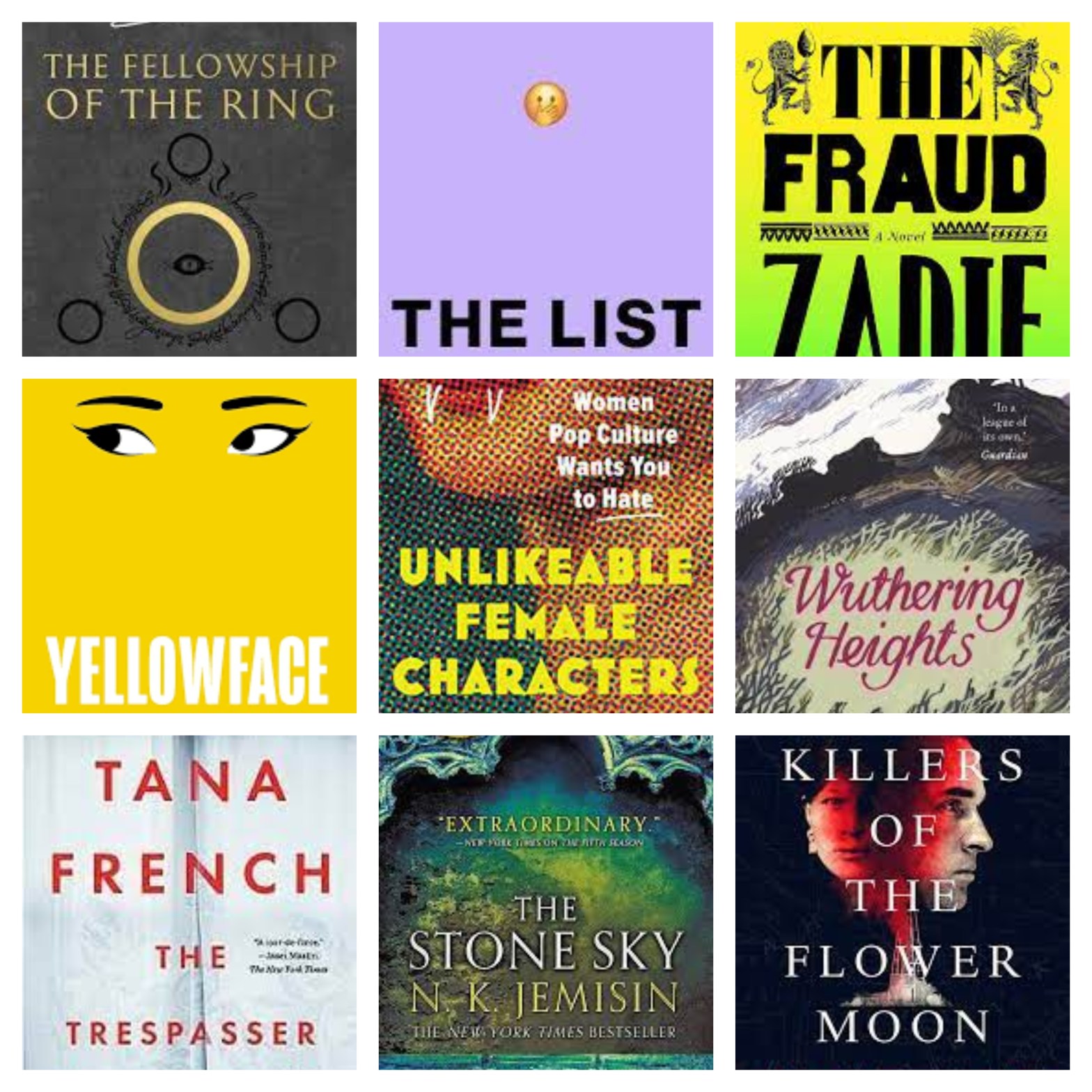
The Fellowship of the Ring by J.R.R. Tolkein

Autumn means a lot of things to a lot of different people. For some it means scary stories around a campfire, for others it means pumpkin spice lattes and cozy scarves. For me, it will always mean Hobbits. Nothing feels more natural to me as reaching for Tolkein as soon as I see the leaves start to change colour. I won’t insult your intelligence by acting as if saying Lord of the Rings is great is a hot take but Tolkein’s simple but powerful story of the forces of goodness and friendship and love and all that is beautiful coming together to save the world will never not hit me right in the feels. It is perfect and it’s what every fantasy writer since Tolkein has been trying to capture, with varying degrees of success. Fellowship is the ultimate comfort read for me and reuniting with Frodo, Sam and all the rest of the Fellowship always feels like returning home again after a long journey.

The List by Yomi Adegoke

Ola has everything going for her. She’s a successful journalist at a feminist magazine, she’s a role model for young black women and she is due to marry her very handsome podcaster boyfriend in just one month’s time, in what promises to be the wedding of the year for the bougie London media set. That all changes when The List is posted on Twitter. The List is a crowdsourced collection of names of men in the public eye accused of everything from garden variety misogyny to sexual harassment to full on sexual assault. Ola’s boss immediately sets her the task of writing an article about The List and normally this is the sort of assignment that she would tackle with gusto. However, this time something has changed. This time her fiancé’s name is on The List. I would categorise this novel as less a story and more of a vehicle to explore the complicated implications of our online culture of anonymity, vigilanteism and black and white morality when it comes up against the love you have for a real, flesh and blood person who you trust and know. It was compulsively readable and also deeply stressful and thought-provoking. Perfect for if you’re looking for a book club pick that will guarantee lively discussion.

The Fraud by Zadie Smith

Many thanks to Netgalley and Penguin UK for this ARC of Zadie Smith’s first historical fiction novel, truly a union of two of my favourite things. One of the best things about Smith’s writing is that way that she can identify and seamlessly weave together seemingly disparate stories and narratives to tell one unified story that leaves you in no doubt of her genius. Here she has centred her story around an historical event called the Tichborne Trial, in which the country was divided over whether a man was truly the long lost Sir Roger Tichborne or a fraud. Our two narrators are Mrs. Touchet, an elderly housekeeper and cousin to a fading literary talent, and Andrew Bogle, a former slave from Jamaica who has aligned himself with ‘Sir Roger’ and finds himself the star witness in the trial. Both are outsiders in society and both are all too aware of the ways in which those on top deceive and exploit those below. This is an engrossing and extremely well-researched novel and what it lacks in narrative momentum, it makes up in power. Smith fans will not be disappointed.

Yellowface by Rebecca F. Kuang

This book had me under a spell for the approximately 24 hours it took for me to read it. Yellowface is the story of June Hayward, a mediocre white author whose debut novel quietly flopped and is now struggling with writer’s block. Meanwhile, her college best friend, Athena Liu, is a literary superstar, churning out novels that are both beautifully written and widely loved. One night, as the two women catch up at Athena’s apartment, Athena suddenly dies, leaving the just-finished manuscript of her latest novel unguarded and ripe for the taking. June steals the manuscript, finishing it off, making it her own and publishing under her racially ambiguous new pen-name, Juniper Song, and finally gets the critical recognition and popularity that she feels she so richly deserves. But Athena won’t be erased so easily and it is one thing to tell a lie and quite another to keep it going in perpetuity. Yellowface is an absolutely gripping novel about racism, cultural appropriation and who is the true owner of a story. June is such a perfectly constructed unreliable narrator, one moment flirting with our sympathies and the next doing something so completely morally bankrupt that my mouth was left hanging open. And yet for all of her (many, many many) flaws, she holds her audience rapt, sitting on the edge of their seat waiting to see what she will do next. Kuang is rocketing her way to the top of my list of favourite authors, not only are her plots utterly gripping but the writing is so sharp and the characters feel so real that when you’re reading her work it’s as if she has you by the throat.

Unlikeable Female Characters by Anna Bogutskaya

What makes a female character unlikeable? Is she a nag like Breaking Bad’s Skyler White? Is she a total psycho like Gone Girl’s Amy Dunne? Or is she just a mean girl in the style of Regina George or Katherine Merteuil? Bogutskaya defines an unlikeable female character as one who reveals the messier parts of her personality and doesn’t fall into conventional standards of morality. As you’ll see from my reviews this month (and every other month), I love an ‘unlikeable female character’ and I’m not alone. They’re often the most interesting characters on the screen and in recent years, shows like Fleabag and Killing Eve have won piles of awards for their portrayals of women getting up to all sorts of messy and toxic behaviour. Bogutskaya traces the development of the unlikeable female character right from pre-Hays Code Hollywood to the present day, paying homage to to all of the brilliant women who brought these characters to life along the way. Whether or not you consider yourself a film buff, this is a fascinating historical and cultural analysis.

Wuthering Heights by Emily Brontë

On wild, wet and rainy October nights, there is nothing that feels more appropriate than busting out the Brontë. This tangled and toxic tale of revenge, generational trauma and the all-consuming, obsessive and incredibly destructive love between Cathy and Heathcliff is a perfect seasonal read, especially when the rain is hitting your window so hard you feel like you have to double check it’s not the ghost of Cathy begging to be let in. I must say though, my favourite part of rereading Wuthering Heights on this occasion was explaining the plot to my husband, whose familiarity with the plot begins and ends with Kate Bush and was fully under the impression that it was a Jane Austen-style romance. Watching his little face fall as I explained just what kind of sociopaths basically everyone in this book is was almost as entertaining as Brontë’s story.

The Trespasser by Tana French

Another fantastic seasonal read. Nothing says spooky season like a murder and goodness knows the Dublin Murder Squad series if full of those (the clue is in the name). Our heroine in this book is Antoinette Conway, the lone female and non-white member of the murder squad and consequently the object of frequent workplace harassment and bullying. Her only ally is her partner, Stephen, who sticks by her even as they get landed with rubbish case after rubbish case by the old boys’ network. Understandably though the whole situation is making Antoinette pretty prickly and paranoid, so when a simple domestic homicide case starts to seem a lot more complicated than it first appeared, Antoinette is questioning her sanity. But is it paranoia if they really are all out to get you? And is Antoinette willing to risk her career to bring down a murderer who might be hiding a little close to home? Maybe even in her own squad room? This was a brilliant end to the series and I think Antoinette was my favourite protagonist yet. I’m sad to see her and the rest of the squad go, but thankfully French has plenty more books to keep me going.

The Stone Sky by N.K. Jemisin

The final instalment in the incredible Broken Earth trilogy, The Stone Sky completely lives up to the potential of the previous books in the series. Here at the end of the world, we find Essun and Nassun on a collision course with each other. Essun, having mastered the power of the Obelisk Gate and seen the way in which orogenes and stills live together in harmony in Castrima, is ready to recapture the moon, end the Seasons once and for all and to build a world in which young orogenes can grow up free. Her long-daughter, Nassun, has very different ideas. Having also harnessed the power of the Obelisks and become harden by the evils she has seen since the start of the Season, Nassun doesn’t see a world worth saving, only one that deserves to be burned to the ground. What is so beautiful about this series is the way the Jemisin has built this world on an epic and grand scale and filled it with incredible magical potential and yet the relationship between Nassun and Essun is the absolute heart of everything, even though they are miles and miles apart for the vast majority of the series. Yes the stakes are high and the fate of the world is at risk, but so much of it just falls away when the two of them are reunited, seeing how they have changed and reckoning with the trauma they both carry and the desperate love that underpins it all. A beautiful end to an incredibly special series.

Killers of the Flower Moon by David Grann

This had been on my TBR list for a little while and the imminent release of Martin Scorsese’s adaption of it gave me a kick up the ass to finally pick it up. I am so, so, glad I did – what an absolutely wild ride! I cannot believe the events of this book actually happened. If I had been given this book and had been told it was fiction I would have thought the whole thing was cartoonishly overwrought and that no actual people are this straight up evil, but once again humanity strives to prove me wrong. The book revolves around the Osage tribe, a group of Native Americans who, after being driven from their ancestral lands by white settlers, cheaply purchased rocky and unfarmable land on which to resettle. In a rare stroke of luck for the Native Americans, that land turned out to be bursting with oil reserves that they were able to lease to oil barons for astronomical fees. Overnight, every member of the Osage tribe became fabulously wealthy but their luck quickly turned sour as members of the tribe start to die mysteriously. What unfurls is a story of corruption, murder, fraud and betrayal, sprinkled liberally with huge amounts of racism towards the Osage people, with twists and turns that will make your head spin. Simultaneously a fascinating true crime tale and a vital story of the resilience and suffering of the Osage people, this was a truly excellent read and had me exclaiming ‘Wait WHAT?’ out loud every ten minutes.

Moon Over Soho by Ben Aaronovitch

By this point in October it was time to make a move from depressingly true crime to truly fantastical crime and so I cracked open the second book in Ben Aaronovitch’s Rivers of London series. We once again meet our protagonist, Peter Grant, an apprentice wizard and one of the Met’s only officers trained to tackle supernatural and magical crime, and this time he’s finding himself haunted by the echoes of jazz standards emanating from corpses. As he starts to investigate what seems to be a case of a ‘jazz vampire’ who sucks the life out of musicians as they perform, Peter finds himself wandering deeper into London’s magical underworld than he ever has before. Once again, Aaronovitch has crafted an immensely readable love letter to London and magic, two things profoundly dear to my heart. My only quibble is that the big twist did seem a touch obvious, but perhaps that’s just because I’m less inclined to be taken in by mysteriously helpful, attractive and horny associates of the deceased than Peter is.

Baba Yaga Laid An Egg by Dubravka Ugrešić

This was a strange little book but that feels fitting given the strangeness of Baba Yaga herself. When a book tries to capture the essence of a woman most famous for living alone in the woods in a house that moves about on a pair of chicken’s legs (icon behaviour imo), you can hardly expect it to be a straightforward tale. Like all old stories this book was confusing and often didn’t quite follow a logic that would make sense in the ‘real world’ and yet the experience of letting it wash over you was decidedly a pleasant one. Because I am an incurable nerd for all things mythology, my favourite section was the last one, which took the form of a letter from an academic that provided analysis of the stories that preceded it. I learned so much about Slavic and Eastern European folklore from this section and it really helped me better appreciate the earlier parts of the book. Putting that structure and guidance in at the last minute actually really added to my experience of reading this novel but I can also see the argument for letting the full unruliness of Baba Yaga run free and offering no explanation whatsoever!

Fragile Things: Short Fictions and Wonders by Neil Gaiman

This gorgeous collection of short stories and poems by Neil Gaiman achieves a perfect balance between delightful and creepy, often within the same story. My highlights were A Study in Emerald, a twisted marriage of Arthur Conan Doyle and H.P. Lovecraft that fed a need I didn’t know I had, Harlequin Valentine, a fabulously eerie love story in which Harlequin (quite literally) gives his heart away and Forbidden Brides of the Faceless Slaves in the Secret House of the Night of Dread Desire, a gorgeously goofy gothic parody and paean to why we read stories that left my cockles feeling toasty warm. I also have to give a shout out to Other People, a story which I cannot say I enjoyed. Rather it left me feeling so disturbed and shaken that I profoundly regretted reading it right before bed. However, this is because it is a truly masterful work of short fiction and I recommend it, along with the rest of the collection, to any Gaiman fans brave enough to crack it open.

The Final Empire by Brandon Sanderson

I have finally hopped on board the Brandon Sanderson hype train and I am now so angry at myself for not having read his books sooner. But at least I now have plenty to catch up on! The Final Empire is the first book in his Mistborn series which features magical warriors or ‘allomancers’ who can harness the power of different metals to wield superhuman strength, influence to the emotions of others or even propel themselves through the air. These powers belong exclusively to the aristocratic classes and are forbidden to the Skaa, an oppressed caste of slaves whose labour and suffering sustains the mighty empire of the immortal and all-powerful Lord Ruler. Enter a group of allomancer criminals who are ready to pull off the biggest heist of all time, leading a Skaa rebellion to overthrow the Lord Ruler and seize his treasury. Led by the charismatic Kelsier, a half-Skaa with an extremely personal grudge against the Lord Ruler, they might just have a chance of bringing this off. But their chances look a lot brighter once they recruit Vin, a half-Skaa orphan of mysterious origins whose powers might surpass even Kelsier’s. However, she has learned to expect betrayal around every corner and while mastering her powers seems to come naturally to her, learning to trust her newfound crew might be harder. Honestly this book was absolutely perfect, full of detailed world-building, a super cool magic system and, most importantly, just a really bloody good story. I’m going to have to sit on my hands to stop myself from going straight to the next book in the series.

The Haunting of Hill House by Shirley Jackson

This is the perfect short read for spooky October nights. The Haunting of Hill House is a masterclass in tension, suspense and dread in which an occult scholar attempts to stage a research trip to a haunted house to observe supernatural phenomena. While his assistants, the vivacious Theodora, insecure Eleanor and charismatic Luke, are not true believers in the paranormal, even they can sense from the very beginning that something is deeply, deeply wrong with Hill House. As strange events become harder and harder to explain away, their initial joviality begins to fray into fractious paranoia, almost as if Hill House itself is seeking to isolate and divide them. Almost as if Hill House wants them vulnerable. Almost as if Hill House has no intention of letting them leave. Read by yourself at night at your own risk, every bump and creak in your house will suddenly start sounding a lot more sinister than usual.

What You Are Looking For Is in the Library by Michiko Aoyama

After the horrors of Jackson, I needed something distinctly cuddlier to cleanse the palette and What You Are Looking For Is in the Library certainly delivered. Aoyama’s novel is essentially five interrelated short stories about people at a crossroads in their lives but are unsure of what direction to take. Whether it’s seeking new purpose after retirement, balancing motherhood and a working life or trying to find the courage to follow a long-cherished dream, each of our protagonists needs a little push to help them find their next step. Fate brings each of them to Hatori Community House and its library, which is run by the mysterious but highly-skilled librarian, Sayuri Komachi. Although people come to her thinking that they know what they need, Ms Komachi seems to have a special ability to identify the exact, often unexpected, book that will give them the guidance they need. This was a real heartwarmer and perfect for anyone looking to embrace the cosy side of autumn rather than the scary one.

Of Ghosts and Goblins by Lafcadio Hearn

I appreciate this may not be the most relatable anecdote that I have, but if you grew up in Ireland and studied Japanese, you heard a lot about Lafcadio Hearn. Hearn is a Greek-Irish writer who travelled to Japan in the late 19th century and who gathered stories of Japanese folklore, translated them and introduced them to a Western audience. Being the great link between Japan and Ireland, he came up a lot over the course of my study of the language for my Leaving Certificate and so I couldn’t resist buying a beautiful, clothbound anthology of his work when I stumbled across it in a bookstore. I read the whole thing in one go on Halloween night and happily lost myself in the strange and eerie world of Japanese demons, goblins and spirits. I highly recommend this to anyone looking for an atmospheric and spooky read this autumn.

My Month in Books: August 2023

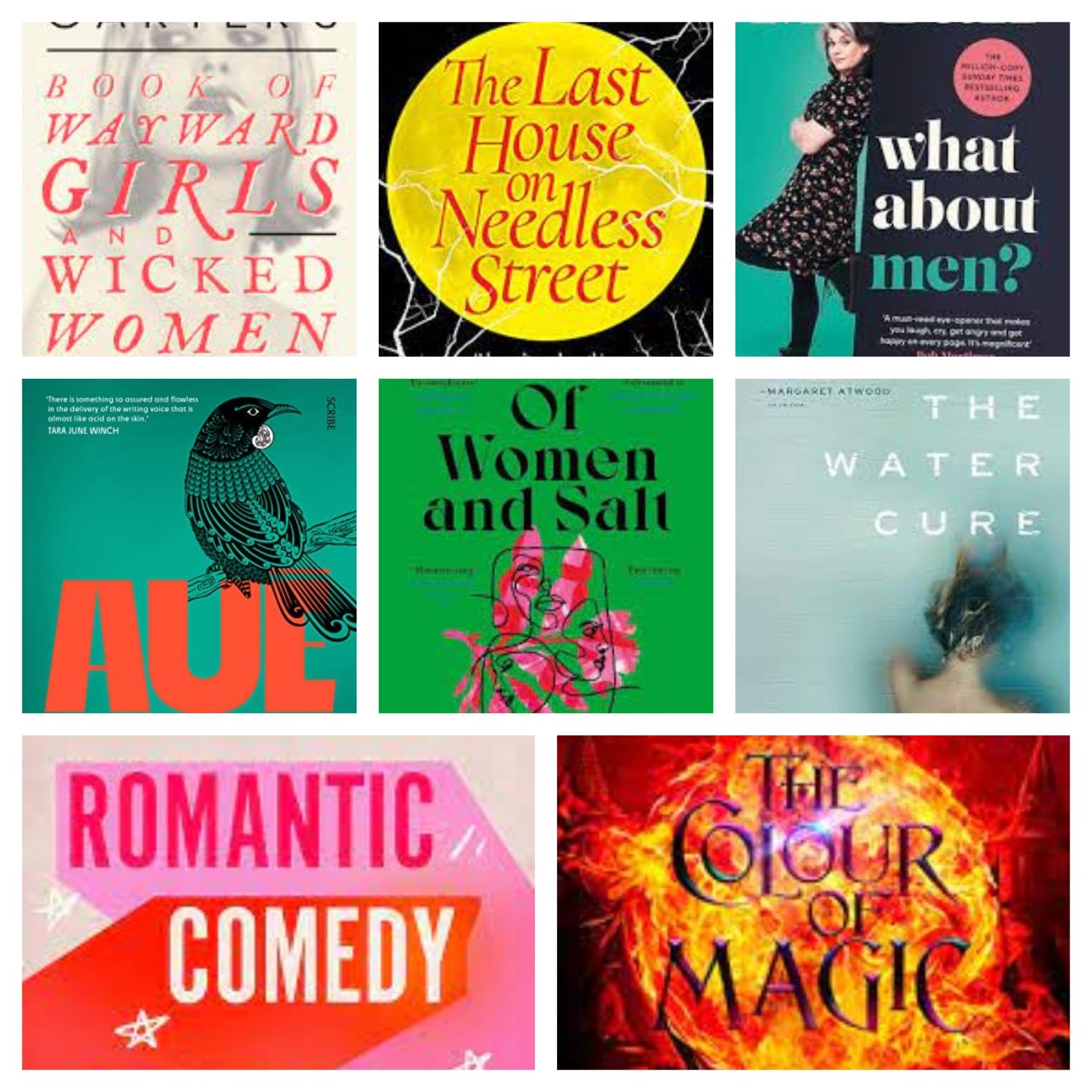
Angela Carter’s Book of Wayward Girls and Wicked Women by Angela Carter

As my book club ventured forth with the rest of womankind to see Barbie together, we wanted to choose a book that was on theme. So, naturally, we landed on this collection of short stories that were chosen by Angela Carter as a a love letter to all the bad girls out there who won’t get in their box and do as they’re told. Highlights for me were Elizabeth Jolley’s ‘The Last Crop’, in which a con-artist matriarch secures comfort for her family through various dodgy means, Leonora Carrington’s ‘The Debutante’, an extremely fun vignette in which a hyena and a young debutante switch places before a ball, Bessie Head’s ‘Life’ in which a woman’s independent streak clashes with the harsh, patriarchal values of her village and, of course, Carter’s own ‘The Loves of Lady Purple’ in which a sexually voracious and much-maligned puppet cuts her strings. Some of the stories dragged a bit but the highs of the collection were suitably high to keep me engaged and eager to see what came next.

The Last House on Needless Street by Catriona Ward

I am deeply cynical about books that claim to have twists that will blow your mind but goddamn did this deliver. Every time I thought I had a sense of where the story was going, everything I thought I knew got completely flipped on its head but without throwing believability and common sense out the window. It’s incredibly hard to summarise this story without giving things away, but suffice to say that there are secrets lurking in the last house of Needless Street and none of our narrators can be trusted to tell the whole truth. This would be a perfect Halloween read, so if you like things spooky, add this to your list.

What About Men?: A Feminist Answers the Question by Caitlin Moran

I’ll be candid, when I first heard Caitlin Moran was writing a book about men’s issues, my first thought was ‘Why?’. I had loved her previous books on feminism and womanhood but was a bit confused about why she was now focusing on men. Aren’t enough things about men? Can’t male authors cover this stuff? But funnily enough, my husband, who isn’t usually a huge reader, was very excited about it and whizzed through it in two days. He loved it and so I then felt like I had to give it a chance. Safe to say that I felt a bit red in the face once I read Moran’s intro, in which she points out that feminists not getting involved in men’s issues and insisting that men sort things out for themselves, while valid, leaves gaping holes to be filled by toxic nutters like Andrew Tate who want to tell men that all of their problems are due to feminism and the ‘woke agenda’. Moran speaks to her male friends and loved ones to explore the difficulties faced by men such as struggling with friendships, discussing their emotions, going to the doctor and the terrifying world of the internet. Moran tackles all of these topics with her trademark humour and empathy and it is a testament to her prowess as a writer that while this is a very easy read it packs a hell of an emotional punch. I have been recommending this book to everyone I know all month and have had so many interesting conversations with my husband and other men in my life off the back of it. Once again, Moran has written a must-read for feminists of all genders.

Auē by Becky Manawatu

My sister-in-law lives in New Zealand and so I have her to thank for gifting me this gorgeous novel and introducing me to Maori fiction. Auē is a Maori expression that can be an expression of both astonishment or distress and both apply to this achingly beautiful family saga which deals with blissful highs but more often crushing lows. Our main characters are a set of brothers, Taukiri and Ārama, who have been left orphaned after their parents were involved in a tragic accident. Traumatised and mired in guilt, Taukiri strikes out on his own, leaving Ārama with their aunt and abusive uncle. As both boys struggle to make their way in a world that seems set against them, snippets of the past are interwoven with their story, revealing the tragedy and violence that has brought the brothers to where they are now. This is ultimately a story about family and love, but it is dramatically underscored by the ferocious struggle that all of the characters have to face to get these things. This book is a punch to the stomach but one that is well worth experiencing.

Of Women and Salt by Gabriela Garcia

Continuing along the ’emotionally devastating intergenerational family sagas’ track, my next read was Of Women and Salt. This historical fiction novel tracks a Cuban family through it’s female line, from 19th century cigar factories to modern day Miami. While the settings change, a common thread across these stories is the impossible choices that women are forced to make and the speed with which others will judge them for them, even the children they made the choices for. While the women of this novel very often don’t understand each other, there is also a strong theme of love, even in the face of violence, addiction, separation and displacement. This book is very short, but if packs a hell of a punch in just a couple of hundred pages.

The Water Cure by Sophie Mackintosh

A strange and soporific novel, centred around a cult-like family, The Water Cure felt as difficult to get a grip on as water sliding through my fingers. Our main characters are three sisters who have been raised in total isolation on an island cut off from humanity, with only each other and their parents for company. Their father speaks of a mysterious toxicity that has spread through humanity that makes this isolation necessary and the girls are forbidden to ever set foot off the island for fear of being infected. But one day their father doesn’t return from a supply run and the girls and their mother are left to fend for themselves. Very shortly after, three strange men wash up on their shores and suddenly the sheltered lives of the sisters are thrown into a dark and disturbing disarray. Ultimately I didn’t really enjoy this, although the stakes were high, the languid tone killed any elements of suspense and left me feeling as if the whole novel was one odd fever dream.

Romantic Comedy by Curtis Sittenfeld

I hope to god Pete Davidson is getting some kind of payout from this book because Sittenfeld has shamelessly ripped off his life. Our protagonist here is Sally Milz, a writer for an iconic late-night comedy show (*cough*SNL*cough*) who finds herself noticing that while her male colleagues often find themselves swept up in whirlwind romances with supermodels, no A-List celebrity men are queuing up to date normal-looking female comedy writers. She pitches a sketch making fun of this phenomenon to this week’s host, incredibly handsome pop-star Noah Brewster ,and finds herself really hitting it off with him as they collaborate on sketches. But as we’ve just discussed, surely there’s no male superstar willing to date a normal woman his own age? Right? What’s fascinating about this book is how grounded in the mundane it is in spite of the glitzy background. In spite of the drama and the glamour of the world of celebrity, the only real obstacle to Sally’s happiness is herself and her own insecurity. While it is physically painful at times to watch her self-sabotage, it makes her eventual coming together with Noah all the sweeter. This is a perfect holiday read.

The Colour of Magic by Terry Pratchett

I have finally embarked on my journey to read the whole of the Discworld series, more or less in order ,and The Colour of Magic is step one on this journey of a thousand miles. Our protagonist is Rincewind, a cowardly wizard who got himself expelled from the Unseen University with one catastrophically powerful spell lodged in his brain. He finds himself playing tour guide to a fabulously wealthy and dangerously naive visitor to the great city of Ankh-Morpork, who is pursued everywhere he goes by a piece of sentient luggage. The various nefarious factions of the Discworld are coming together to fleece this trusting tourist and Rincewind finds himself going to the ends of the earth (literally) to save himself and his new companion. While this doesn’t feel like Pratchett at the height of his powers (ONLY ONE FOOTNOTE????), his trademark humour and charm is still firmly on display as the reader is introduced to this very special fantasy world (which happens to rest on top of four elephants, standing on a turtle).

My Month in Books: July 2023

Infamy: The Crimes of Ancient Rome by Jerry Toner

Normally I’m always quick to pick up a book on the ancient Romans, but I grabbed this one double quick because Jerry Toner was actually one of my supervisors at university. He’s a fantastic teacher who runs a course on Roman popular culture and under his wise guidance I got to study (and write very long essays on…) everything from graffiti to spell books to collections of jokes to better understand the cultural world of the average ancient Roman, not just the elite ones we so often read about. If that sounds appealing to you but you’re not lucky enough to be in Jerry’s class, Infamy is a pretty good substitute. In his usual fashion, Jerry looks at Roman society from the bottom up and draws on a range of unorthodox sources (always a thrill to see a reference to the Testament of the Piglet) to paint a vivid portrait of crime and justice in the ancient world. While I am a total nerd for all things Roman, this book is still clear and accessible enough for anyone to make a go of it and Jerry has an informal and engaging style that stops the book feeling dry at any point. For anyone looking to better understand the Roman world beyond the verses of Ovid and the writings of Cicero, this book is a great place to start.

Stone Blind by Natalie Haynes

I was clearly on a Classics kick in July because I went straight from the back streets of Rome into the wonderful/horrifying world of Greek myth. Stone Blind is a feminist retelling of the myth of Medusa, the infamous Gorgon with snakes for hair and who could turn men to stone with a single glance. But what many don’t realise is that Medusa wasn’t always so frightening to behold and that she was cursed with snaky hair and a deadly gaze by Athena. What could possibly merit such a harsh punishment you ask? Being raped by Poseidon in Athena’s temple. Ultimately this is a story about the myriad ways in which patriarchy wreaks havoc on the lives of all women, whether they are victims of violence like Medusa and Danae or whether they are seemingly insulated from harm by their privilege like Athena and Hera. Once again Haynes draws on multiple perspectives of women across a range on ancient myths the breath new life into lesser-known stories and showing that although these stories are thousands of years old, they still have something relevant and insightful to say to us now.

Happy Place by Emily Henry

Emily Henry has firmly cemented herself as my go to author for light, happy reads. Her latest rom-com centres around Harriet and Wyn, a young couple who’ve been together since college and who spend every summer at an idyllic beach house in Maine with their close-knit but geographically scattered group of friends. When the friends find out that this beach house is due to be sold and that this will be the last year they can spend there, the other long-term couple in the group decide to throw a last minute surprise wedding at the beach with just their very closest pals making up the guest list. Sounds perfect, right? The catch is Wyn and Harriet broke up six months ago and had planned to use this holiday to break it gently to their friends. Now lest the death of their relationship cast a shadow not just over the holiday but also the wedding of two of their closest friends, the two resolve to spend the week pretending that they’re still together. This goes predictably and hilariously wrong and misunderstandings and miscommunications abound. Once again, Henry has crafted a charming novel that’s such easy reading you’ll scarcely notice the pages fly by but with enough heart and grit to make you really feel something.

Horrorstör by Grady Henrdrix

Does anyone else get a sinking feeling in the pit of their stomach whenever they walk into an IKEA? Something about all that empty, soulless furniture, the disorientation caused by the lack of natural light and the echoing void of the warehouse just sets my teeth on edge. Clearly Hendrix agrees with me that IKEA is cursed but he has taken it to a far more frightening extreme than I ever could have dreamed! Horrorstör is set in ‘Orsk’ a totally-not-IKEA, pseudo-Skandi megastore that stocks all of your homeware needs. But recently employees have been coming in to find furniture destroyed, the store defaced and no evidence of who could be responsible on their security cameras. Three employees with nothing to lose volunteer to work an overnight graveyard shift to catch the vandals they presume are behind the destruction but they are in for a series of nasty surprises lurking behind the Kjerring bookshelves. This book scare the bejeesus out of me (DO NOT READ HOME ALONE AT NIGHT) while also keeping me so engrossed that I read it in a day. I don’t really ask too much more from a novel other than keeping me entertained and keeping me guessing but Hendrix really went above and beyond by delivering a novel that did all of the above while also asking some very interesting questions about the nature of work and what it means to be responsible. Recommended to any horror fan!

A Spool of Blue Thread by Anne Tyler

This is my very first time reading Anne Tyler and I have to say, I was totally and completely charmed. While this book is a little light on plot, it more than makes up for it by being heavy on character. A Spool of Blue Thread revolves around the Whitshank family, with their history across three generations unspooling at a leisurely pace. At first their problems are ordinary ones; fraught parent-child relationships, tough decisions about how to care for ageing parents and sons-in-law with harebrained business ideas. But as you get to know the family better and begin to peel back the layers of time, the unconventional nature of the Whitshanks begins to shine through and a family that once seemed utterly ordinary is rendered extraordinary. This is a perfect read for anyone looking for something that will both relax and engross you and I’ll be adding Tyler to my list of authors whose books I take on holiday with me.

Y/N by Esther Yi

The phrase ‘Y/N’ likely means ‘yes or no’ to most normal people, but to young women of my generation who grew up on Tumblr and Fanfiction.net, it will always mean ‘your name’. It refers to a specific genre of fan-fiction in which an author allows the reader to insert their own name into the story and thus live out a fantasy of being (usually) romantically linked to a fictional character or a celebrity. When our protagonist, a young Korean-American women living in Berlin, finds herself falling suddenly and obsessively in love with a member of a stratospherically popular K-Pop boyband (*cough*BTS*cough*) she gives shape to her feeling and longing by writing Y/N fan-fiction. As she sinks deeper and deeper into the world of fandom, she loses interest in her relationships, her job and anything that isn’t the object of her desire. When the news breaks that her idol is retiring from the music industry and he vanishes from the public eye, she flies to South Korea to be with him. But there is a tremendous difference between reality and fantasy, between obsession and love, between an idea and a person and all of this is thrown into sharp relief when she finally comes face to face with her beloved. This is not a book so much about obsessive fan culture as it is about love in an almost existential or spiritual sense. Her love for her idol is almost akin to a religious veneration and her quest almost feels like a pilgrimage. Although this novella is brief, it’s definitely not what I would consider a light read and packs a hell of a punch. I’d recommend this for those who are looking for philosophical musings rather than propulsive plot.

Rivers of London by Ben Aaronovitch

This series has been on my list for forever and I’m so glad I finally got around to it! When I need something to get me out of a reading slump, I reach for a fantasy novel or a detective thriller and Rivers of London seamlessly merges both into a highly readable and engrossing novel. Our protagonist is Peter Grant, a young constable with London’s Metropolitan Police who is on the brink of being banished to the Casework Progression Unit to file other detectives paperwork for the rest of his days. All of this changes when he finds himself taking evidence from a key witness to a strange and brutal murder. The catch? The witness is dead. Now awakened to a London full of ghosts, magic and gods who walk among us, Peter finds himself apprenticed to Chief Inspector Nightingale, the Met’s expert on supernatural crime. But the learning curve is steep and the bodies keep piling up, so Peter has to master magic quickly or risk losing access to this new world as quickly as he gained it. I have already downloaded the next book in this series onto my Kindle and I can’t wait to dive in.

A Problem From Hell: America and the Age of Genocide by Samantha Power

You might not be surprised that I found a book about genocide depressing, but it’s not for the reason you think! While obviously Power’s thorough analysis of major genocides in the 20th century, including Armenia, Cambodia, the Holocaust, Srebrenica and many more. While these atrocities are horrifying in themselves (though I did appreciate that Power didn’t dwell too much on gruesome details of torture, instead relying on the emotional accounts of survivors’ trauma to give weight to the horrors they had endured), what I found most dispiriting was the international community’s seeming indifference to the suffering of those beyond their own borders. Although ‘never again’ has been the mantra of most Western governments in the aftermath of the Holocaust, well-documented cases of genocide have been allowed to continue virtually unopposed since then. Focusing on American foreign policy responses, Power analyses why this is the case, exposing the weak arguments that lie at the heart of the case for non-intervention and also presenting her own arguments for why taking a strong stance against genocide is not only the right thing to do morally but is also essential to protecting US interests in the long term. She also explores the origins of the UN Convention on Genocide and the International Criminal Court, shining a light on one of history’s lesser known heroes, Raphael Lemkin, a lawyer and a linguist who coined the term genocide and campaigned relentlessly to have it recognised as a crime under international law. His passion and single-mindedness is astounding and I couldn’t believe I had never heard of him before. He and many other passionate campaigners against atrocity were the bright spots of what could have otherwise been a bleak read. While there are still Lemkins in the world pushing governments to live up to their promises of ‘never again’, there is still hope that genocides can be stopped in their tracks.

My Month in Books: May and June 2023

The Heroine’s Journey: Women’s Quest for Wholeness by Maureen Murdock

If, like me, you picked this book up thinking that it is a feminist response to Joseph Campbell’s idea of the Hero’s Journey, you’ll find yourself disappointed. Less literary theory and more self-help, Murdock posits that women have been defined according to masculine values and successes and that a heroine must reconnect with the ‘wounded feminine’ in order to achieve a state of wholeness. I was with her up to a point (always happy to participate in the dismantling of patriarchal institutions) but the whole thing felt just a bit too much like gender essentialism with some crystals and new age mysticism sprinkled in to distract you. While I enjoyed the sections that actually focused on mythology and goddess narratives, the long sections on the author’s dreams felt a tad irrelevant to the overall aim of the book. Ultimately The Heroine’s Journey feels remarkably dated and too narrow to actually help anyone looking to learn more about narrative and story-telling so I definitely don’t recommend it for those purposes.

I Shall Wear Midnight by Terry Pratchett

There’s yet to be a Discworld novel that I don’t love, but there will always be a special place in my heart for Tiffany Aching and her Wee Free Men. In this installation Tiffany must balance her responsibilities as witch of the Chalk with addressing increasingly violent anti-witch sentiment and preparations for her ex-kinda-boyfriend’s upcoming nuptials. Pratchett really is a master of cloaking very real truths about coming of age and being an outsider in a fantasy setting to create stories that feel fantastical and transporting and yet also incredibly true and relatable. These books are so special to me and I’m dreading the day that I reach the end of the series.

The Hidden Life of Aster Kelly by Katherine A. Sherbrooke

Perfect for fans of the The Seven Husbands of Evelyn Hugo and Daisy Jones and the Six, The Hidden Life of Aster Kelly is a highly readable historical fiction novel that grapples with the price of success, the value of found family and the conflict that so often ensues out of the public eye when the two collide. A dual narrative, with one half focusing on the glamorous Aster Kelly in 1940s and her dreams of becoming a fashion designer as the world tries to pin her into the role of model and muse, and the other half focusing on her daughter Lissy in 1970s New York as she tries to make a name for herself on the Broadway stage. If you’re looking for an engrossing, intelligent read to keep you entertained this summer that’s still light enough to read on the beach, this book is for you.

Strong Female Character by Fern Brady

If you’re not already a fan of Fern Brady, sort your life out because she is outrageously funny. I’ve been following her stand up for ages and in it she is quite open about her recent diagnosis of autism. So I was surprised when reading her memoir about how much she resisted the idea that she was autistic and how much shame she initially associated with her diagnosis. The memoir itself is a hard-hitting and furious account growing up as a neurodiverse woman in working-class Glasgow and tackles mental health, abusive relationships, educational struggles and sex work. It is a testament to Brady’s incredible talent that in spite of its pretty heavy subject matter, it is still immensely entertaining to read. Brady’s pitch-black sense of humour keeps the story flowing while never letting the reader lose sight of the invisible barriers that neurodiverse women face. Whether or not you are autistic, this book with both entertain and educate you.

Butler to the World: How Britain Helps the World’s Worst People Launder Money, Commit Crimes and Get Away with Anything by Oliver Bullough

As the world rushed to sanction Russia following their invasion of Ukraine, suddenly it felt like everyone was talking about the issues of dirty money, kleptocracy and economic crime. Although there is seemingly a political consensus in the U.K. on the need to crack down on illicit finance, Bullough’s detailed polemic against Britain’s role in the global offshore economy makes it uncomfortably clear that this is a very recent development indeed. He begins his story in the aftermath of the Suez Crisis in 1956 when Britain is still reeling from humiliation and having an identity crisis about their role in the world as their once immense influence wains. Bullough posits that in the absence of any particular hard power of its own, Britain fashioned itself into an enabler and fixer for the the world’s dodgiest oligarchs. Whether it’s the arcane system of Scottish limited partnerships, gambling tax rates in Gibralter or tax havens in the Cayman Islands, Britain has and continues to play an outsize role in facilitating financial dirty tricks and this book is a must read for anyone who wants to understand how much further there is to go in closing these loopholes.

The Chalk Man by C.J. Tudor

The Chalk Man is a thriller that alternates between two timelines, one in the 1980s, when a young Eddie and his friends leave each other childish chalk messages around town until a gruesome murder gives their symbols disturbing new significance, and one now, as an adult Eddie grapples with what happens all those years ago and begins to look at them with fresh eyes as some of his old friends begin to turn up dead. While there were plenty of twists and turns, they were fairly predictable and I didn’t find the plot particularly compelling. This was a perfectly passable thriller with which to pass the time but I’d need it to be significantly more thrilling before I recommended it!

After Sappho by Selby Wynn Schwartz

I’m pretty sure this book was genetically engineered in a lab to make me happy. Historical fiction about the feminist movement? Check. Copious amounts of love for Latin and Ancient Greek? Check. Communities of female artists and thinkers creating beautiful work together? Check. Everyone is a lesbian? Check. This novel of vignettes of brilliant and transgressive female creatives throughout the late nineteenth and early twentieth century is sweeping, empowering and beautifully written. I cannot recommend it enough and if there is any justice in the universe then spirit of Sappho knows that this book exists and is weeping with joy to see all of the brilliant women who are her legacy.

The God of Small Things by Arundhati Roy

This novel has been on my list for a long time and it was a real pleasure to finally sit down and enjoy it. The God of Small Things is a tragic but beautiful story of a family on the brink of destruction and Roy guides the reader through the series of seemingly small events that move them inexorably towards disaster. The characters are vividly drawn and truly feel like real, fully fleshed out people, whether they tug at your heartstrings or make you want to punch them in the face. Roy’s writing is dream-like, winding you through space and time at a leisurely pace, while still being grounded firmly in the reality of India in the late sixties and the caste-based discrimination that was rife at the time. I know this book has been controversial but I found it to be a deeply moving joy to read and heartily recommend it.

Who Gets Believed?: When The Truth Isn’t Enough by Dina Nayeri

Halfway between memoir and essay, Who Gets Believed? poses fascinating questions about the nature of truth and belief and the seemingly small and irrational things that render someone ‘credible’. Nayeri draws on her experience of the asylum system, consultancy, childbirth and more to put the spotlight on the unspoken social codes that regulate who we as a society choose to trust. What I found particularly interesting about this book is that Nayeri is no less critical of herself than she is of the rest of the world, spending a significant amount of time interrogating why she struggles to give credence to her brother in law’s mental health struggles and the significant amount of guilt and shame she carries around the judgements she made on that topic. This thought-provoking book should prompt all of us to take a closer look at who we trust implicitly and who we still feel distrustful of, in spite of what’s right in front of our eyes.

The Rachel Incident by Caroline O’Donoghue

I’m a huge fan of Caroline O’Donoghue’s fantastic podcast Sentimental Garbage and so I was thrilled when NetGalley sent me an advance copy of her latest novel in exchange for a review. As I’d hate to have to say anything less than complimentary about someone so cool, I’m thrilled to say that it fully fulfilled my high expectations and I thoroughly enjoyed it! The Rachel Incident is set in Cork in the late 2000s as Ireland is reeling off the back of a recession and employment is scarce. Our protagonist, Rachel, has just moved in with her brilliant, charismatic and closeted co-worker and the two of them tear up the Cork nightlife as they embrace an artsy and bohemian lifestyle. But when their lives become increasingly entangled with the life of Rachel’s married English professor, Dr Byrne, things begin to spiral out of control very quickly. I love how this novel captures the rush of mad, passionate and all-encompassing friendship, the glories and horrors of being an absolute mess in your twenties and the claustrophobic nature of growing up in a country where everyone seems to know everyone else and therefore your mistakes can haunt you for years to come.

Lady Chatterly’s Lover by D.H. Lawrence

One of the most controversial books of all time of its not only because of its explicit descriptions of sex and pleasure but also for its depiction of a relationship that crosses class boundaries, Lady Chatterly’s Lover is a great work of literature in its own right as well as a window into the anxieties of the British establishment in the Inter-War period. The novel centres around the eponymous Lady Constance Chatterly, a passionate young woman whose aristocratic and intellectual husband has been injured in World War I. He is completely paralysed from the waist down and Constance quickly finds herself acting much more as a nurse and a secretary than a wife, with her husband neglecting her emotional and physical needs and insisting that their marriage can go on perfectly happily even if they only engage with each other on an intellectual and logical level. Constance finds herself wasting away, unable to live a life of the mind and craving a connection to the physical world of nature and emotion. On her regular long walks through the grounds of their estate, she strikes up a relationship with Oscar Mellors, the gamekeeper, and the two embark on a passionate love affair that turns Constance’s world upside down. Absolutely a novel that must be read at least once over the course of a lifetime.

Snow Country by Yasunari Kawabata

Another novel fraught with frustrated passion and loving descriptions of nature, but this time set in the snowy mountains of western Japan. There’s not much by way of plot in this novel, which recounts the one-sided but passionate affair between a Tokyo business man and a rural geisha and the enigmatic young woman who will obliviously throw it into disarray. From the beginning a sense of doom and sorrow underscores the affair but the beauty is in how Komako, the geisha, continues to throw herself fully it even knowing that she is destined to be left heartbroken. This is a sparse and beautiful novel, much like the snowy landscape where it is set, but do not be fooled into thinking it is dull. Like a great white tundra it can appear plain and empty but a curious eye and patience will reveal that it sparkles in the right light.

Northanger Abbey by Jane Austen

I think it’s fair to say that Northanger Abbey is very much the red-headed stepchild of Jane Austen’s oeuvre. A slightly odd mish-mash of gothic parody, meta-textual commentary on novels, a comedy of manners and a love story, I can understand why this particular Austen novel is not for everyone. I, however, am ride or die for Catherine Morland and think that if you’re skipping Northanger Abbey you’re missing Austen at her sassiest. She is at the peak of her powers in the earlier scenes set in Bath, effortlessly skewering society’s more loathsome characters and summoning heart-pounding tension from seemingly low stakes social interactions. There is no other author living or dead capable of making me want to scream ‘let her out of that damn carriage’ on a crowded train. What truly makes Northanger Abbey charming though it its heroine. While Catherine is a walking disaster who manages to obliviously create chaos wherever she goes, she is so well-intentioned and so single-minded in her desire to do the right thing that you cannot help but root for her, even as she sort of accuses her prospective father-in-law of murdering his wife. A true hidden gem in the Austen canon.

The Price of Salt by Patricia Highsmith

Many will know The Price of Salt better through its film adaption Carol, which stars Cate Blanchett and Rooney Mara. However, even if you’ve seen the film, the novel is still well worth your time. Another tale of repressed longing that goes against the social mores of its time (I’ve clearly been in a mood recently), The Price of Salt tells the story of Therese, a young set designer who falls passionately and obsessively in love with Carol, an older woman who is going through a divorce. The two embark on a clandestine affair but when Carol’s husband gets wind of their relationship, Carol is forced to choose between continuing to have access to her child and continuing her relationship with Therese and living her life authentically. Although it is the centre of the novel, the love story here left me feeling rather cold – I couldn’t really see what was keeping Therese and Carol together other than all that forbidden passion and sexual attraction. However, I was moved by the elements of the story which focused on Therese’s coming into herself and coming of age. While as a romance it leaves something to be desired, as a Bildungsroman and coming out story, The Price of Salt excellent.

A Gathering of Shadows by V.E. Schwab

It’s always a shame when a sequel doesn’t live up to the potential of the excellent first book in the series. I was totally captivated by A Darker Shade of Magic’s great world-building, tightly knit plot and engaging characters but unfortunately A Gathering of Shadows has lost its way. It’s clear that Schwab is building to something with this series but this book just felt like filler to get us there rather than an engaging story in it’s own right. I cannot for the life of me understand the point of the whole Element Games plot line and the extremely contrived means by which our main characters participated in it stretched the bounds of common sense even for a fantasy novel where extra-dimensional travel is possible. I’ll still be giving the next book in the series a shot in the hopes that it returns to something resembling its initial brilliance, but even if it does its still disappointing that the magic couldn’t last the whole way through the series.

Babel: An Arcane History by R.F. Kuang

This is legitimately one of the best novels I’ve ever read. Babel is set in an alternative version of Oxford in the late 1800s in which the British empire has grown richer than ever before using ‘silverwork’, a form of magic that stems from the things that are lost in translation from one language to another. To keep the magic flowing, the empire must rely on the linguistic talents of young people from the farthest corners of the world, bringing them to Oxford and giving them the chance to rise high as valued cogs that keep the wheels of expansion and conquest turning. But some are not content to allow the British to run roughshod over their motherlands and our heroes must decide how far they are willing to go fight back against the empire. A stunning book that manages to be an immaculately constructed fantasy world, a gripping story of revolution, a polemic against the insidious nature of colonialism, a love letter to language and a meditation on what it means to translate, this novel ticked boxes I didn’t even know I had and I cannot recommend it enough.

My Month in Books: March and April 2023

Hell Bent by Leigh Bardugo

When a novel ends with a character proposing quite literally going to hell and back again to rescue a friend, it’s more than a little cruel to keep your readers waiting nearly four years for a follow-up. However, I am willing to forgive Leigh Bardugo because Hell Bent is worth the wait. Building on the delightfully creepy world-building from the first book in this series, Alex Stern is back and in even more trouble than ever as she and her allies must race against time to rescue Darlington from the pits of hell, wrangle the (literal) ghosts that haunt them, solve a mysterious string of murders and face up to the darkest secrets of their past. I love how this book fleshed out many of the characters who surround Alex and gave them fuller backstories while also giving her the space to develop into a richer character in her own right. I look forward to seeing where the series goes from here but I imagine I’ll have a few more years to wait to find out.

Five Tuesdays in Winter by Lily King

Thank you to NetGalley and PanMacmillan for providing me with an ARC of this short story collection. This is a collection of stories that centre on characters across the spectrum of genders, ages and socioeconomic status but are united by a shared focus on heartache, longing and loss. The experience of reading this collection feels oddly nostalgic, with almost all of the stories feeling as if you’re looking back on a different time through the forgiving haze of memory. The stand-out stories for me were definitely the eponymous Five Tuesdays in Winter, in which a gruff bookstore owner slowly falls in love with his employee and works up the courage to make his move, and North Sea, in which a recently widowed woman takes her daughter on holiday for the first time since her husband’s passing. Although both stories seem very different, they both have a strong, hopeful undercurrent running through them as the protagonists begin to move forward from their past disappointments and losses. This is an uplifting, beautifully written collection and I’d recommend it to anyone looking for a serotonin boost that will still challenge them.

Other People’s Clothes by Calla Henkel

I hate when the blurb of a book promises a complex, gritty psychological thriller and what you get instead is a plodding and confused tale of sad millennials numbing their pain in an artsy way before everything goes absolutely batshit in the last 150 pages. This book was trying very very hard to be ‘twisty’ but instead just felt incoherent and unsure of where it wanted to go. It was an absolute mishmash of buzzy tropes, including ‘intense/homoerotic female friendship’, ‘extravagant partying to cope with pain’, ‘weird relationship with older woman the protagonist works for’ and ‘making the most self-destructive choice possible at any given moment.’ After pages and pages, of artsy angst we finally get to the juicy/murder-y parts and I nearly get whiplash from how often the story flips itself around and not in a good way. I wish the author had condensed the ‘depressed white girl in her early twenties’ section into a some sort of literary montage and actually spent time fleshing out the more thrilling parts of the book. Definitely do not recommend.

So Lucky by Dawn O’Porter

This book was a bit of a weird one and not really in a good way. Centring around three women who seemingly have it all together, O’Porter dives beneath the surface to illustrate how even the people who look the most perfect can be falling apart inside. Part of me however feels that her purpose might have been better served by having her characters have slightly less bizarre problems (though I will admit, having one of the big dramatic reveals being that one character just had lots of body hair was truly surprising, though not really in a good way). The ‘big twist’ could be seen coming from space and while all of the characters coming together to support each other at the end was interesting, I can’t say that their actions were particularly coherent. For a novel that purports to be about looking below the surface, all of the characters felt too shallowly drawn to really care about.

See What Can Be Done: Essays, Criticism and Commentary by Lorrie Moore

I love getting to read books that make me feel as if I’m getting smarter as I’m reading them and See What Can Be Done is absolutely one of those books. Lorrie Moore is best known for her short fiction but is also a regular contributor to the New York Review of Books, writing essays on literature, film, television and current events. Although I wasn’t familiar with every topic that Moore was writing on, it was still a treat to read her thoughts as she has a wonderful way of talking about culture. It was a real pleasure to spend some time wandering around in her brain and I feel I now have plenty of new things to add to my read and watch list as a result of her reviews!

The Confessions of Frannie Langton by Sara Collins

I was initially a little bit nervous picking up this book as I’m not a fan of reading narratives of slavery that veer too far into ‘misery porn’ and focus only on the relentless suffering of their protagonists rather than portraying them as fully-realised human beings. Imagine my delight when I found that The Confessions of Frannie Langton seems to be a direct rebuke to precisely those kinds of narratives, with Frannie expressing disgust at the white abolitionist cliques in London who salivate over hearing tales of the horrors of slavery and deny her any agency and ownership over her own life. The novel opens with Frannie, a mixed race ex-slave, imprisoned and accused of the murder of her employers and her odds of avoiding the hangman’s rope look pretty dire. Her lawyer pleads with her to give him something, anything, that he can turn into a defence to save her neck and so Frannie begins to tell him the story of her life. It is full of tragedies and joys, love and loathing and underpinned throughout by a thirst for knowledge and frustration at her circumstances. Ultimately this story is a furious scream at a world that would try to erase and ignore the lives of women like Frannie and I would highly recommend it to fans of historical fiction.

I’m Glad My Mom Died by Jennette McCurdy

I’m Glad My Mom Died is a memoir of a childhood lost to fame and abuse and a slow journey towards recovery and self-love. In the hands of most storytellers, this story would be hard to get through but it is a testament not only to McCurdy’s talent as a writer but also her resilience and sense of humor that she somehow makes a harrowing tale into a darkly funny page-turner. Jennette McCurdy was a child actress on the popular Nickelodeon show, iCarly, and to the outside world it looked as if she had everything going for her. But what no one realised (or cared about) was that this was not a life she had chosen for herself. Dragged to her first audition at six years old by her abusive and overbearing mother, McCurdy’s childhood is a blur of acting classes, home makeovers, forced calorie restriction and a huge amount of emotional manipulation whenever she tries to resist. For years she is trapped in a cycle of addiction, unhealthy relationships and disordered eating, until her mother dies of cancer and she finally is able to examine their relationship and her mother’s impact on her life at a healthy distance. I’m not usually much of a fan of memoir, but McCurdy’s is compulsively readable and captivating, I hope she goes on to write more.

Fix the System, Not the Women by Laura Bates

In a world where it feels as if we’re constantly being bombarded with news stories about women being harassed, attacked and killed, I’m so grateful that we have Laura Bates on hand to highlight the systemic problems that lurk unseen behind every incident. Drawing heavily on her work with the Everyday Sexism Project, Bates exposes the prejudices and biases that lie at the core of five key institutions; Education, politics, media, policing and criminal justice. She rails against the lack of creativity or urgency behind previous attempts to address systemic misogyny and demands a society in which the safety of women is considered to be of equal importance to the comfort of men. An excellent and succinct primer on institutional sexism and a powerful rallying cry for change.

The Year of Magical Thinking by Joan Didion

The Year of Magical Thinking is a beautifully written and heartrending account of the strangeness and trickery of grief. When Didion’s husband dies suddenly of a massive coronary episode while their only child is in a medically induced coma, she is thrust into the chaotic and subjective land of the grieving. Her memory is fuzzy, she cannot write and she finds herself keeping her husband’s shoes in case he needs them when he gets back. On top of all of this, while her daughter initially recovers, a mere two months later she suffers from a massive subdural hematoma, requiring extensive brain surgery and weeks of slow recovery. Being Joan Didion, of course she manages to turn experiences that would have broken anybody else into an insightful and empathetic walk through the process of grief, blending her prose with excerpts from psychological studies, great works of literature, poetry and music. This is a deeply human and personal story about how it feels to lose a someone and reading it will prompt you to hold all of your loved ones a little bit closer.

My Monticello by Jocelyn Nicole Johnson

My Monticello is a novella centring around Da’Naisha, a young descendent of Thomas Jefferson and his slave, Sally Hemmings. When her neighbourhood is attacked by violent white supremacists, Da’Naisha, her family and her neighbours take shelter in Monticello, Jefferson’s historic home. Here, as she and her companions try to come together to survive a much wider white supremacist uprising than they initially anticipated, Da’Naisha must also grapple with the burdens of her inheritance and the future of her family. With Monticello standing in for a country that is Da’Naisha’s by right but that many are desperate to shut her out of, this brief but powerful story makes a worthy contribution to the war currently being waged over who owns America’s history.

The Penguin Book of Japanese Short Stories edited by Jay Rubin

While I was lucky enough to be travelling through Japan, I decided that it was the perfect time to expand my knowledge of Japanese literature. This is the perfect book with which to do that. Jay Rubin has collected a series of stories that span genres and centuries to create a captivating and varied collection that gives the reader a glimpse into the spirit of the country. Unusually rather than being ordered alphabetically or chronologically, the stories are arranged by themes such as ‘Nature and Memory’, ‘Modern Life and Other Nonsense’ and ‘Dread’. My personal highlights were The Story of Tomoda and Matsunaga by Jun’ichiro Tanazaki, which provides a surreal but engrossing gateway into the collection, Patriotism by Yukio Mishima, which is a stunningly beautiful story about two heartbreakingly futile deaths, The Tale of the House of Physics by Yoko Ogawa, a tale of memory, longing and nostalgia and Hell Screen by Ryunosuke Akutagawa, a slow-burning horror story of artistic obsession. A special mention has to also go to Hiroshima, City of Doom by Yoko Ota, which I read on the bullet train to Hiroshima itself and provided a timely reminder of the enormous human cost of the the Hiroshima bombing and the terror of those who experienced it firsthand. If you’re not lucky enough to be visiting Japan soon, I recommend this collection as a way of transporting yourself there much more quickly and cheaply!

Kitchen by Banana Yoshimoto

Another novel I read while in Japan and my first time reading Banana Yoshimoto. I was completely swept up into the emotional and warm world of love, found family and grief that Yoshimoto created in both Kitchen and its companion story Moonlight Shadow. Both stories are written in spare, simple prose and feature young female protagonists grieving a loss but eventually finding closure and reading them truly felt healing. Although the stories are short, you feel as if you are on a journey and by the end of the novel you are left with an overwhelming sense of satisfaction and wholeness. Because they are both so short, the whole book can easily be consumed in one afternoon and so there is no excuse not to treat yourself to reading this next time you’re feeling down.

Fairy Tale by Stephen King

While I acknowledge that Stephen King is a master, I normally don’t read his work because I’m the biggest wuss of all time when it comes to scary stories. So imagine my delight when I saw his latest book was less horror and more epic fantasy. The first third or so of the book introduces us to our young protagonist Charlie Reade, a star athlete and all-around good guy with a tough home life. When he intervenes to save his reclusive, elderly neighbour after he falls off a ladder, Charlie strikes up a friendship with the old man and falls in love with his ancient but spirited dog. But when his neighbour dies, Charlie finds himself not just the guardian of the dog and the old house, but also a mysterious portal to another world hidden in the back garden. Left with a dangerous mission and armed with nothing but a good heart, strong legs and a loyal dog, Charlie must rescue this new world and his own from the evil forces that seek to choke the life from it. King has captured all of the strange magic of a classic fairy tale while creating something entirely original and this is a must read for fantasy fans.

Well Traveled by Jen DeLuca

For me, the fantasy in this romantic comedy revolves less around love and more around the idea of quitting my job to run away with a Renaissance Fair. Our protagonist is overworked and under-appreciated lawyer, Lulu, who opens the novel having a mental break down at a Renaissance Fair and throwing her work phone in a bucket of water. While she figures out her next move, she opts to travel along with the fair and finds herself falling for local ladies’ man, Dex. What I did enjoy particularly about this book was that the central conflict between the two lovers was less about improbable feats of miscommunication and more about the fundamental incompatibility of their two lifestyles. What I liked even more was that neither of them sacrificed their passions for the other, but rather communicated and worked together to find a compromise that would require some sacrifices but ultimately make both of them happy. It felt more grounded and realistic than similar novels I read, which I wasn’t expecting from a novel in which the administrative needs of travelling psychics are a major plot point but hey, I love to be surprised!

Sightseeing by Rattawut Lapcharoensap

A very good friend of mine has headed off to travel the world (If you’re reading this, hi Sam!) and in lieu of going with her, my book club has decided to read along with her travels. Her first stop was Thailand and so we cracked into this collection of short stories which are in equal parts insightful, amusing, devastating and triumphant as they paint a picture of a country struggling to define itself against the backdrop of an encroaching tourist industry. The absolute highlight of this collection for me was Cockfighter, a novella which tells the story of one man’s desperate fight for fairness and dignity against a local gangster as told through the eyes of his daughter. The reader is caught between rooting for his victory but fearing for his life and the life of his family if he doesn’t cut his losses and surrender to the inevitable victory of the local gang. I was completely engrossed in this story, anxiously flipping pages to find out what happened next. This story is worth buying the collection for on its own but the other stories that sit along side it are also an excellent read.

My Month in Books: February 2023

The World We Make by N.K. Jemisin

The City We Became was one of my absolute favourite reads of 2020 and I was buzzing with excitement to hear more from the five avatars of New York City and explore the other living cities of the world. Jemisin, as always, delivers a gripping and creative novel full of breathtaking world-building. However, my only critique is that the whole thing does feel somewhat rushed. This makes sense once you learn that Jemisin originally intended for Great Cities to be a trilogy rather than a duology but I still found myself feeling as if the pacing was a bit too fast for me. I’m also left wanting to know more about all of the other living cities who Jemisin gives us a tantalising glimpse of. Basically my main critique of this book is that there isn’t more of it, so I shall have to content myself with devouring the rest of Jemisin’s extensive oeuvre.

A Visit From the Goon Squad by Jennifer Egan

A Visit From the Goon Squad is a tightly woven collection of short stories that broadly revolve around music producer Bennie Salazar and his assistant Sasha. Although their lives and pasts are largely hidden from each other, the reader is plunged into an array of vivid snapshots of the lives of their friends and associates, from Bennie’s high school friends to Sasha’s strange uncle to the children of Bennie’s reckless mentor. I found myself particularly moved by Great Rock and Roll Pauses a short story told from the perspective of Sasha’s daughter entirely through the medium of a Powerpoint presentation. You might think it sounds like a strange thing to be moved by a Powerpoint presentation, but such is the power and vulnerability of Egan’s writing. While the subject matter is varied and could have felt chaotic if written by a lesser author, Egan instead creates a symphony where all of the different, interlocking parts come together in perfect harmony to tell us a story about longing, art, self-destruction and redemption and the way that time comes for us all.

Sense and Sensibility by Jane Austen

When life gets a little bit much, it’s always nice to be able to retreat back into an old favourite. Revisiting the romantic travails of the Dashwood sisters still evokes all the passionate responses of the first time (namely a strong desire to shake Edward Ferrars, slap Lucy Steele into next week and condemn John Willoughby to a life of appropriate child support payments) but because this story is so familiar I have the comfort of knowing that in spite of all the tortured silences, the fraught letters and the dramatic walks in the rain that a happy ending is just around the corner. Sense and Sensibility is bursting with Austen’s signature wit and whether it’s your first time reading this or your fifth, you can’t help but be delighted.

If On A Winter’s Night A Traveller by Italo Calvino

Summarising this book will be extremely difficult because it is less a story and more an experimental treatise on what it means to be a reader. The novel opens with a direct address to the reader, asking them to sit down and make themselves comfortable as they settle in to read a new book by Italo Calvino (so far, so meta). But after a few pages, the reader discovers that there is a printing error and the book just endlessly repeats the first section. Desperate to finish the story, the reader returns to the book shop to purchase a replacement but instead is given another book entirely and meets a mysterious and intriguing other reader. Thus begins a cycle of starting brand new stories only to have them cut short and find them replaced with another story entirely, leaving both the fictional reader and the reader themselves flitting through romances, comedies, thrillers, erotica and horror with each one mulling on what it means to read and why we do it. While I can’t say I particularly enjoyed this book (honestly I was hoping for more of a story) I think that Calvino has unquestionably produced a fascinating and innovative novel.

Ship Wrecked by Olivia Dade

All good things must come to an end, including Olivia Dade’s extremely fun Spoiler Alert series. Centring on the cast of a wildly popular big-budget fantasy TV series with a terrible ending and useless show-runners (totally not Game of Thrones), this series has provided a fabulous source of warm and fuzzy feelings as well as copious nerdy fanfiction nostalgia. However, I found this last instalment a little underwhelming. I think the reason for this is that the main characters are isolated from the rest of the cast and so we don’t get as much of the characters we’ve grown so fond of over the course of the series. I also have a funny feeling if I was Swedish that I would hate this book because the sheer volume of national stereotypes and Swede jokes floating around would have probably driven me insane. Ultimately though, this was a fun, light read that still delivers plenty of good vibes, even if it doesn’t quite live up to its predecessors.

Ninth House by Leigh Bardugo

This was actually a reread for me but I wanted to refresh myself on the story ahead of the sequel finally coming out (you’ll have to wait for next month for that review!). This is a gripping paranormal thriller that centres around Alex Stern, a young woman who can see dead people, is understandably pretty messed up as a result and whose life has taken a few wrong turns. When she wakes up in a hospital bed after being found as the sole survivor of a brutal mass murder, she is offered an escape – a full ride scholarship to Yale. However, everything comes with a price. In exchange for this golden opportunity Alex must monitor Yale’s eight infamous secret societies to ensure they aren’t getting up to too much mischief. But this isn’t just supervising frat parties. The societies have been practicing magic for centuries and Alex’s natural gifts make her a perfect fit for making sure that their rituals don’t go too far. She struggles to adapt to New England, her classes and her new mentor in all things magical but when a local girl turns up murdered on campus, Alex, ironically, comes alive. Dealing with death is something she is familiar with and she’s prepared to square off against the privileged society members to make sure this girl gets justice. Full of twists, turns and spooky surprises, this book is perfect for fans of dark fantasy.